Vehicle Scrapping Policy in India: Rules, Incentives and What Owners Must Do
17 July, 2026
RTO
Old vehicles do not just get less reliable with age. Under Indian law, they eventually reach a point where they cannot legally stay on the road at all unless they pass a formal fitness check. The vehicle scrapping policy is the framework that governs exactly when that happens, what owners are required to do about it, and what financial benefits are available if you choose to scrap a vehicle rather than keep renewing it. This guide walks through the rules in plain terms.
What the Scrapping Policy Covers
The vehicle scrappage policy India introduced in 2021 targets one specific problem: old, unfit, and heavily polluting vehicles staying on the road well past the point where they are safe or clean to drive. Rather than banning old vehicles outright, the policy sets an age threshold at which a vehicle must pass a formal fitness and emissions test to keep running.
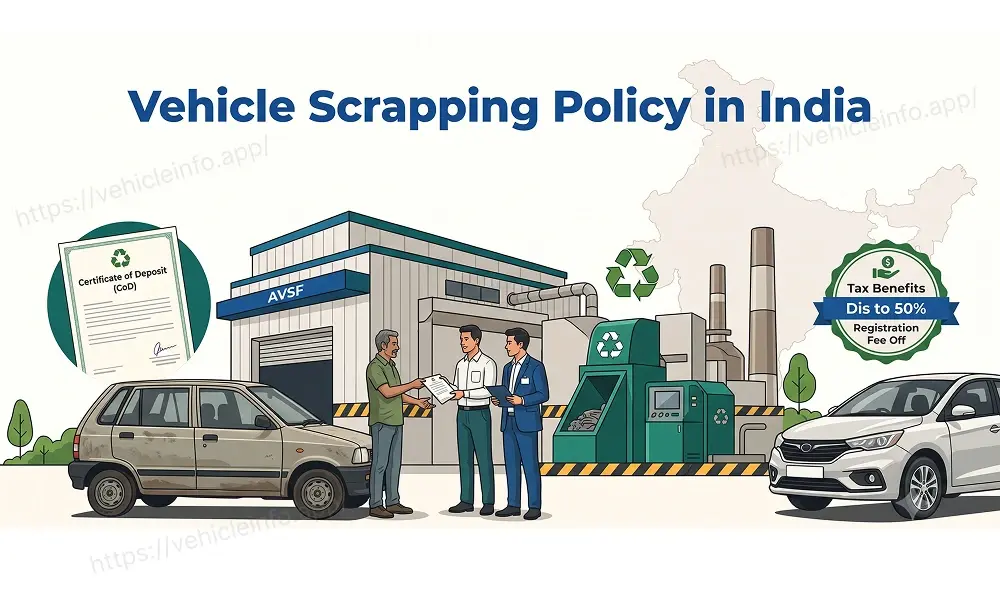
The system works through two types of facilities. An Automated Testing Station, or ATS, is where the fitness test itself happens, using machine-based checks on braking, emissions, structural condition, and safety systems rather than a manual inspection. A Registered Vehicle Scrapping Facility, or RVSF, is the authorised centre where a vehicle that fails the test, or one an owner chooses to retire voluntarily, is dismantled and recycled under regulated conditions.
Age Limits for Private and Commercial Vehicles
The vehicle scrapping policy sets different age thresholds depending on how a vehicle is used.
Private, non-commercial vehicles, including cars, bikes, and SUVs, must undergo a fitness test once they cross 20 years from the date of registration. Commercial vehicles, such as trucks, buses, and taxis, face a shorter threshold of 15 years, reflecting the heavier use and higher pollution output typically associated with commercial operation.
If a vehicle passes its fitness test, it can continue to be used, and private vehicles can typically renew their registration for another five-year block, while commercial vehicles get a shorter renewal window, often just one year at a time, given the more frequent testing requirement. If a vehicle fails, it is officially classified as an End of Life Vehicle, or ELV, and its registration is cancelled. Continuing to drive a vehicle once it has been marked an ELV is illegal and can lead to fines or the vehicle being impounded.
Vintage and classic vehicles that are well maintained and used only occasionally, such as for exhibitions or heritage events, are generally exempt from these age-based testing requirements, provided they are registered under the appropriate vintage vehicle category rather than for regular road use.
Scrappage Incentives and Certificate of Deposit
A common question people ask is what is the vehicle scrapping policy in India actually gives owners in return for retiring an old vehicle, since testing and compliance alone would be a fairly one-sided deal. The answer is a defined set of financial incentives, all tied to a document called the Certificate of Deposit.
- When you hand over a vehicle to an RVSF for dismantling, whether because it failed its fitness test or you chose to scrap it voluntarily, the facility issues this certificate as proof that the vehicle was scrapped through an authorised, regulated channel. That certificate then unlocks several benefits when you buy a new vehicle:
- Scrap value, typically around 4 to 6 per cent of the old vehicle's original ex-showroom price, is paid directly by the RVSF
- A waiver of registration fees on the new vehicle
- A road tax rebate, which can run up to 25 per cent for private vehicles and around 15 per cent for commercial vehicles, depending on the state
An additional manufacturer discount, commonly in the range of 5 per cent, is offered by many vehicle makers against a valid Certificate of Deposit
Together, these are a meaningful scrappage incentive, often adding up to a noticeable chunk off the price of a replacement vehicle, particularly once the road tax rebate and registration waiver are combined with the manufacturer discount.
How to Deregister and Scrap a Vehicle Legally
Scrapping a vehicle properly is a documented process, not simply handing your keys to the nearest scrap dealer. Here is the general sequence:
- Locate an authorised Registered Vehicle Scrapping Facility near you, rather than an informal or unregistered scrapyard
- Submit the vehicle along with its Registration Certificate, a valid ID proof, and an affidavit confirming the vehicle is free of pending loans, insurance claims, theft cases, or court disputes
- The RTO cross-checks these details, sometimes including a diligence report from police and crime records, before approving deregistration
- Once approved, the RVSF dismantles the vehicle, removing hazardous materials and the number plate as part of the regulated recycling process
- You receive the Certificate of Deposit, which you then use to claim your scrappage incentives on a new vehicle purchase
Following this process matters beyond just the incentives. Using an unauthorised scrapyard means the vehicle's registration may never be formally cancelled, which can leave you exposed to future liability, fines, or challans tied to a vehicle you no longer physically own but which still exists on paper as registered in your name. This is really the core of how to scrap a car legally: the paperwork and the physical scrapping need to happen together, through an authorised facility, for the process to actually protect you.
What Happens to Insurance and RC
Scrapping a vehicle does not automatically cancel its insurance policy or its RC. These are separate administrative steps that need to be handled alongside the physical scrapping.
Once you have the Certificate of Deposit and proof of deregistration, you can submit these to your insurer to formally cancel the policy. If time remains on the policy term, insurers are generally required to refund the unused premium for that period. If you had accumulated a No Claim Bonus on the policy, most insurers will issue a transferable NCB certificate, which you can then use toward a discount on a new vehicle's insurance premium, preserving the value of a claim-free history even though the original vehicle is gone.
The RC itself is cancelled as part of the deregistration process handled through the RTO, and this cancellation is what the Certificate of Deposit and affidavit ultimately support. Skipping this step, or assuming that physically scrapping a vehicle automatically closes out its records, is one of the more common mistakes owners make, and it can leave loose ends that surface later, such as continued road tax liability or an active RC showing against a vehicle that no longer exists.
FAQs
1. What is the vehicle scrapping policy in India in simple terms?
Ans: It is a government framework that requires private vehicles over 20 years old and commercial vehicles over 15 years old to pass a fitness test to keep running, and offers financial incentives to owners who choose to scrap a vehicle at an authorised facility.
2. What is the age limit for scrapping a car under this policy?
Ans: Twenty years for private cars from the date of registration, and fifteen years for commercial vehicles. A vehicle that fails its fitness test at that age must be scrapped rather than continue on the road.
3. Is scrapping compulsory once a vehicle hits the age limit?
Ans: Not automatically. The vehicle must undergo a fitness test at that age. If it passes, it can continue running and its registration can be renewed. Only a vehicle that fails the test is required to be scrapped.
4. How to scrap a car legally without losing money or running into future liability?
Ans: Take it to an authorised Registered Vehicle Scrapping Facility, complete the deregistration paperwork through the RTO, and collect the Certificate of Deposit, which both protects you legally and unlocks the scrappage incentives on your next vehicle.
5. What is a Certificate of Deposit in the context of the car scrapping policy?
Ans: It is the official document that an RVSF issues once a vehicle is scrapped through the authorised process. It proves legal scrapping and is required to claim road tax rebates, registration waivers, and manufacturer discounts on a new vehicle.
6. Does the vehicle scrappage policy India apply to two-wheelers as well?
Ans: Yes. Two-wheelers follow the same general age thresholds and fitness testing requirements as other private vehicles under the vehicle scrappage policy India runs nationally, and owners can access the same category of scrappage incentives.
7. What happens to my insurance if I scrap my car?
Ans: It does not cancel automatically. You need to submit the Certificate of Deposit and deregistration proof to your insurer to formally close the policy and claim any unused premium refund or NCB transfer.
8. Are vintage cars covered under the end of life vehicle rules?
Ans: Generally no. Vintage and classic vehicles registered under the appropriate heritage category and used only occasionally are typically exempt from the standard age-based fitness testing requirements.
9. What happens if I keep driving a vehicle that failed its fitness test?
Ans: It is classified as an End of Life Vehicle with cancelled registration, and continuing to drive it is illegal, potentially leading to fines and impoundment.