Green Tax on Vehicles in India: Who Pays, How Much, and When
17 July, 2026
RTO
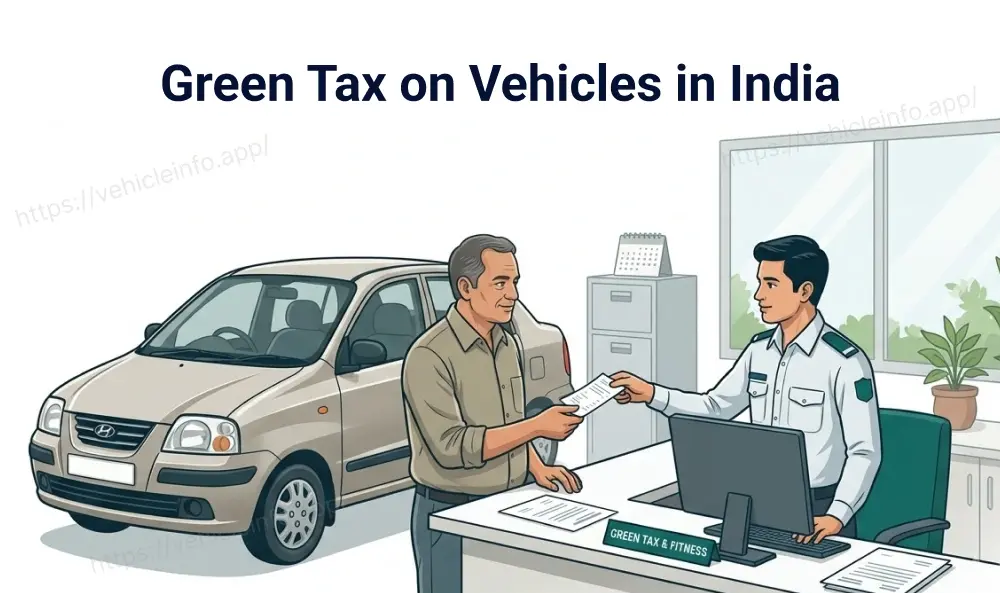
If you own a car or bike that is approaching 15 years old, you may soon come across a charge on your renewal notice that was not there before. This is the green tax on vehicles India levies on ageing vehicles, and it catches a lot of owners by surprise simply because nobody expects an extra fee at renewal time. Understanding green tax for vehicles early, well before your own car or bike reaches that age, makes the eventual bill far less of a shock. Here is what it is, who actually pays it, and how much it typically costs.
What the Green Tax Is and Why It Exists
Green tax, sometimes called an environmental tax or pollution tax, is an additional charge collected from older vehicles at the point of registration renewal or fitness certificate renewal. It is not a one-time fee paid at purchase like road tax. It only appears once a vehicle crosses a certain age threshold.
The logic behind the green tax for vehicles is straightforward. Older engines generally pollute more than newer ones, since they were built to older emission standards and tend to wear down further with age. Rather than banning old vehicles outright, the tax makes holding on to one more expensive with each passing year, nudging owners toward either properly maintaining an ageing vehicle or eventually retiring it in favour of something cleaner.
Which Vehicles and Which States It Applies To
The green tax on old cars applies once a private vehicle passes 15 years from its registration date. Commercial vehicles, including trucks, buses, and taxis, become liable sooner, typically once they cross 8 years, reflecting their heavier use and higher average emissions.
Fuel type also matters. Electric vehicles are exempt from green tax across virtually every state, since the entire point of green tax on vehicles in India is to discourage polluting vehicles specifically, and EVs do not fall into that category. CNG vehicles are exempt in most states for similar reasons, and some states extend a partial exemption to strong hybrid vehicles as well.
Because vehicle taxation is a state subject in India, the exact rules and rates are set individually by each state government rather than through a single uniform national rate. This means the amount you actually owe, and sometimes even whether the green tax applies at all for a particular vehicle category, depends heavily on where the vehicle is registered. Delhi-NCR is a notable special case, since National Green Tribunal orders there restrict certain very old diesel and petrol vehicles from running at all, making the green tax question somewhat moot for those specific vehicles since they cannot legally operate regardless of any tax payment.
Green Tax Rates by Vehicle Age
The green tax rate is generally calculated as a percentage of the vehicle's existing road tax rather than as a fixed rupee amount, which is part of why the bill can vary so much from one vehicle to another even within the same state.
For commercial vehicles, the typical range is 10 to 15 per cent of the annual road tax liability. For private vehicles, the range runs considerably higher, commonly up to around 50 per cent of the road tax amount in many states, though the exact figure depends on local rules. As a rough illustration, if a private vehicle's road tax works out to roughly six thousand rupees, a green tax rate toward the higher end of that range could add an additional two to three thousand rupees at renewal.
Some cities apply even steeper charges tied specifically to pollution levels. In Delhi, for instance, an Environment Compensation Charge applies separately to commercial vehicles entering the city, layered on top of the standard green tax structure for vehicles registered there. Because rates genuinely differ this much by location, the most reliable way to know exactly how much is green tax for a car in your specific case is to check directly through the Parivahan portal or your state's transport department, rather than relying on a single number that applies everywhere.
How It Connects to Re-Registration and Scraping
Green tax does not exist in isolation. It is deliberately timed to align with two other processes: registration renewal and the vehicle scrapping framework.
For those wondering when you pay the green tax, the answer lies in your vehicle RC. For private vehicles, this typically falls at the point of RC renewal after the vehicle passes 15 years of age, then again at each subsequent renewal cycle. For commercial vehicles, since fitness certificates are renewed more frequently as a vehicle ages, green tax re-registration charges tend to come up on a tighter, often yearly, cycle once the 8-year threshold is crossed.
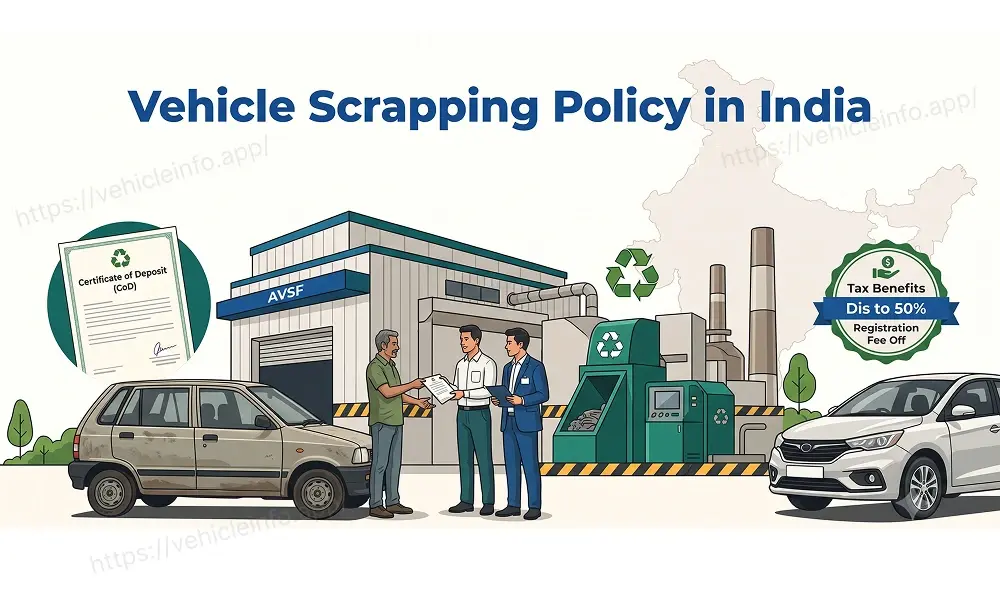
This timing is not a coincidence. The age thresholds for green tax broadly track the same milestones that trigger mandatory fitness testing under India's vehicle scrapping policy, which requires private vehicles to pass a fitness test at 20 years and commercial vehicles at 15 years. Green tax functions as an earlier financial signal along that same timeline, effectively telling owners that costs are about to rise well before the harder scrapping deadline arrives.
For owners weighing whether to keep an ageing vehicle running or scrap it, green tax is one input among several. Rising insurance premiums on older vehicles, increasing repair costs, and the accumulating weight of green tax payments at each renewal can together make scrapping and claiming the associated incentives, such as a road tax rebate and registration waiver on a replacement vehicle, a more attractive option than continuing to pay to keep an old vehicle roadworthy.
FAQs
1. What is green tax on vehicles in India in simple terms?
Ans: It is an extra charge collected from older, more polluting vehicles at the time of registration or fitness certificate renewal, meant to discourage keeping high-emission vehicles on the road indefinitely. The green tax on vehicles in India is applied through state transport departments rather than a single central authority.
2. How much is green tax for a car typically?
Ans: It varies by state, but private vehicles commonly see a rate up to around 50 percent of their existing road tax, while commercial vehicles typically face a lower rate of 10 to 15 percent of road tax.
3. When do you pay green tax exactly?
Ans: At the point of registration certificate renewal for private vehicles after 15 years, and at the fitness certificate renewal for commercial vehicles after 8 years.
4. Is the green tax the same everywhere in India?
Ans: No. Since vehicle taxation is a state subject, each state sets its own green tax rate and specific rules, so the amount can differ significantly depending on where the vehicle is registered.
5. Are electric vehicles exempt from green tax?
Ans: Yes, virtually everywhere. Electric vehicles do not carry the emissions profile that the tax is designed to address, so they are exempt in every state that levies a green tax.
6. Does the green tax apply to two-wheelers or only cars?
Ans: It generally applies to both, though the specific rate for two-wheelers is usually lower than for four-wheelers, reflecting their smaller engines and lower typical emissions.
7. How do I pay green tax on old cars if it applies to my vehicle?
Ans: Most states allow payment through the VAHAN portal or the mParivahan app, where you enter your registration number, verify via OTP, and pay the amount shown alongside any other renewal dues.
8. Can I avoid the green tax by scrapping my vehicle instead of paying it?
Ans: Yes, in a practical sense. Scrapping an eligible old vehicle and claiming the associated incentives on a replacement avoids the recurring green tax liability entirely, since the tax only applies to vehicles that continue to be registered and used.
9. Does the green tax replace the road tax, or is it charged in addition to it?
Ans: It is in addition. Green tax is calculated as a percentage of the existing road tax rather than replacing it, so an eligible older vehicle owner pays both. This is one detail that trips up a lot of first-time payers when the green tax for vehicles first shows up on their renewal notice.