Bike Insurance Rules in India: Legal Requirement, Third-Party Mandate and Penalties
16 July, 2026
Bike Insurance
If you own a two-wheeler in India, one question that might bug you is whether bike insurance is mandatory or is it something you can ignore. This guide walks through the bike insurance rules India follows under the law, including what counts as valid cover and what happens if you skip it. Read on to know everything about bike insurance rules in India.
Is Bike Insurance Mandatory in India? The Answer You Must Know
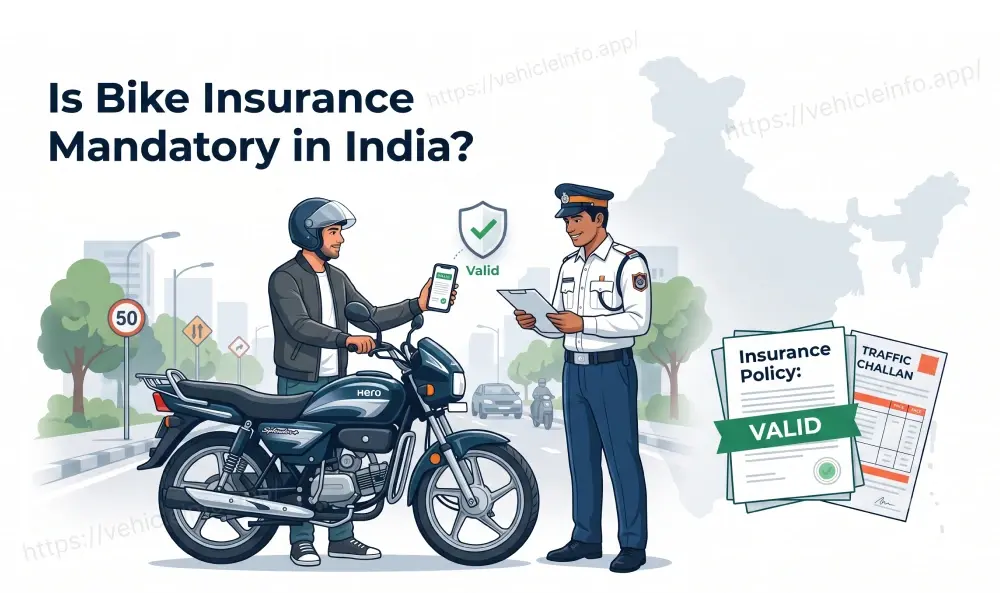
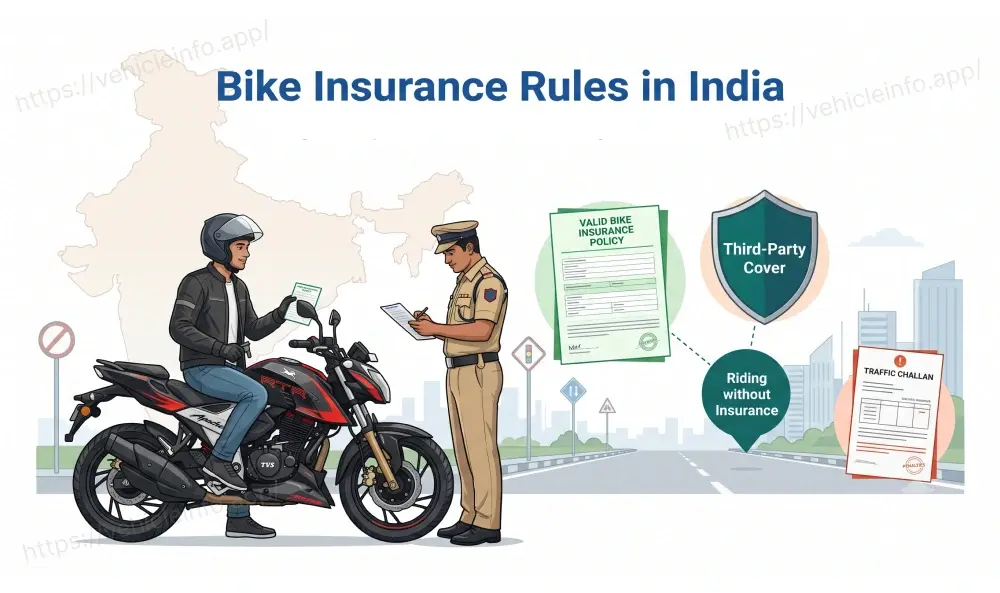
Under the two wheeler insurance law that applies across the country, every motorcycle and scooter used on a public road must carry at least a valid third-party insurance policy. This is not a state-level rule that varies by location. It comes from a central law, the Motor Vehicles Act 1988, and it applies the same way whether you ride in Mumbai or a small town in Bihar.
The confusion usually comes from a different question. What kind of cover is mandatory? A lot of riders assume that any insurance, even an expired or lapsed one, satisfies the law. The reality, however, is that it does not. The bike must be covered by an active, currently valid policy at all times.
What the Motor Vehicles Act Says About Two-Wheelers
The legal foundation of mandatory bike insurance is Section 146 of the Motor Vehicles Act, 1988. It states that no person can use, or allow another person to use, a motor vehicle in a public place unless there is a valid insurance policy in force for that vehicle. Two-wheelers fall squarely under this requirement, the same as cars, trucks, and buses.
Section 147 of the same act then defines what that policy must actually cover, setting the minimum protection an insurer has to provide. Together, these two sections form the backbone of MV Act bike insurance compliance. They do not care whether your bike is a 100cc commuter or a 650cc tourer. The obligation to carry insurance is the same.
The Legal Minimum Cover for Bike Owners in India
Here is a distinction that confuses a lot of owners. The law does not require you to buy comprehensive insurance, which also protects your own bike against theft, accident damage, or fire. It only requires third-party cover, which protects other people and their property from damage your bike causes.
Third-party insurance pays for:
- Injury or death caused to another person
- Damage caused to another person's vehicle or property
It does not pay for damage to your own bike. If your comprehensive policy has lapsed but you have never had insurance at all, you are not compliant with the law regardless of how good your riding record is. Comprehensive cover is a smart upgrade for financial protection, but third-party is the floor the law sets, and it is what makes the bike insurance rules India enforces actually satisfactory.
Long-Term Third-Party Rule for New Bikes
If you bought your two-wheeler new after September 2018, there is a good chance your third-party cover is not an annual policy at all. Following a Supreme Court direction in S. Rajaseekaran v. Union of India, IRDAI made it compulsory for new two-wheelers to be sold with a long-term third-party policy covering five years, paid as a single premium at the time of purchase.
This rule exists because a large share of uninsured vehicles on Indian roads were bikes whose owners simply forgot to renew a one-year policy. A five-year term removes that annual renewal risk for the third-party portion, though the own-damage portion of a comprehensive package is still typically renewed yearly.
Under current IRDAI-notified rates, the five-year third-party premium works out to roughly Rs 2,901 for bikes up to 75cc, Rs 3,851 for 75cc to 150cc, Rs 7,365 for 150cc to 350cc, and Rs 15,117 for bikes above 350cc. On an annual basis, the same slabs work out to about Rs 538, Rs 714, Rs 1,366, and Rs 2,804, respectively. These rates are fixed by IRDAI and stay the same no matter which insurer issues the policy, so there is no room to negotiate the third-party portion, only the own-damage add-ons if you choose comprehensive cover.
What Counts as Valid Cover at a Police Check
A common worry among riders is what actually satisfies an officer during a spot check. The rules here have moved with the times. You no longer need to carry a printed policy document. Valid proof includes:
- A physical copy of the insurance certificate
- A digital copy stored in DigiLocker
- A policy record visible on the mParivahan app
The Ministry of Road Transport has notified that documents stored digitally in DigiLocker or mParivahan carry the same legal weight as the physical original. If your policy is active but you cannot immediately produce a document, an officer can also cross-check the registration number against the VAHAN database, since insurers feed policy data into that system directly.
Penalty for Riding Without Insurance
Riding without valid cover is treated as an offence under Section 196 of the Motor Vehicles Act. This is the section that carries the actual two wheeler insurance penalty, and it applies whether it is your first time being caught or not.
First Offence
For a first violation, the penalty is a fine of Rs 2,000, imprisonment of up to three months, or both, at the discretion of the court or the compounding process handled through the challan system. In practice, most first offences are settled by paying the fine through an e-challan rather than a court appearance.
Repeat Offence
If you are caught a second time or more, the fine rises to Rs 4,000, with the same possibility of imprisonment of up to three months. Repeat violations tend to draw closer scrutiny, since the pattern suggests the rider is deliberately avoiding insurance rather than having let a single policy lapse by accident.
Beyond the direct fine, riding uninsured also removes your legal cushion in the event of an accident. Without a policy in force, you personally bear the full cost of any injury, death, or property damage claim a third party brings against you, which can run into lakhs of rupees depending on the severity of the accident.
How Insurance Links to RC, PUC, and the Fitness Certificate
Bike insurance does not exist in isolation. It is one part of a set of documents that the RTO expects to be in order together. Your Registration Certificate (RC), your Pollution Under Control (PUC) certificate, and your insurance are increasingly cross-checked as a bundle, particularly during renewal cycles or when applying for any RTO service online.
For instance, some services on the Parivahan portal, such as certain ownership transfers or duplicate RC applications, will flag or block the request if the insurance on record has expired. This linkage is part of a broader push to make insurance compliance harder to sidestep, since a lapsed policy can now quietly interfere with unrelated paperwork you need to get done at the RTO.
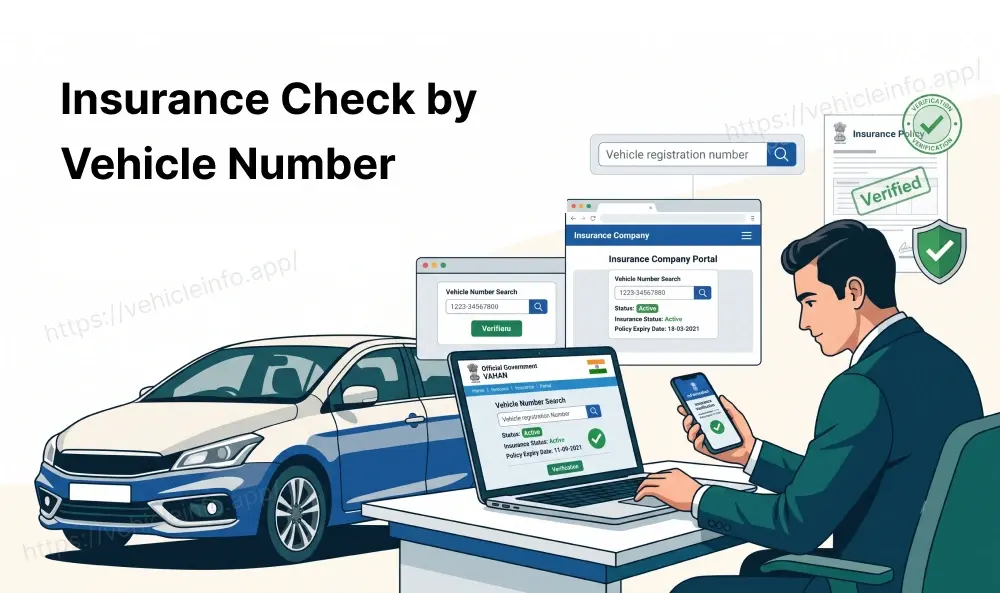
How to Verify Your Bike Insurance Status on VAHAN
If you are ever unsure whether your policy is showing as active, the fastest way to check is directly on the VAHAN portal or the mParivahan app.
- Open the VAHAN citizen services page or the mParivahan app
- Enter your bike's registration number
- Complete the CAPTCHA if using the website
- Review the insurance section of the result, which typically shows the insurer's name and the policy's validity dates
Keep in mind that this record is not always instantaneous. Insurers push updates to VAHAN periodically, so a policy bought or renewed in the last few days may not show up immediately. If you renewed recently and the portal still shows an expired status, wait a few days before assuming there is a genuine problem.
What Happens If Your Policy Lapses
A lapsed bike insurance policy is more than an administrative inconvenience. The moment your third-party cover expires, you are legally uninsured, even if the lapse was unintentional.
There are financial consequences too. If you let a comprehensive policy lapse for an extended period, most insurers require a fresh inspection of the bike before issuing a new policy, and your No Claim Bonus, if you had one, is typically at risk once the lapse crosses a certain window, often around 90 days. Renewing promptly, ideally before the expiry date rather than after, avoids both the legal exposure and this financial reset.
Rules for Electric Two-Wheelers
Electric bikes and scooters fall under the same core legal requirement. Third-party insurance is mandatory for electric two-wheelers exactly as it is for petrol models, since the Motor Vehicles Act does not distinguish by fuel type when it comes to the insurance mandate.
Where electric two-wheelers differ is in how the premium is calculated and priced. Instead of being based on engine cubic capacity, electric vehicle premiums are calculated using motor power output in kilowatts. IRDAI has also approved a discount, generally around 15 percent, on the third-party premium for electric vehicles compared to an equivalent petrol model, as an incentive for cleaner mobility. In practical terms, this means a small electric scooter with a motor output of around 3 kilowatts typically carries a lower annual third-party premium than a similarly sized petrol scooter, even though the legal obligation to carry that cover is identical.
Common Myths About Bike Insurance Rules in India
A surprising number of riders misunderstand how the bike insurance rules India follows actually work. Clearing up a few common myths helps avoid accidental non-compliance.
Myth: My bike is old, so insurance does not matter as much.
The two wheeler insurance law makes no exception for the age or value of the vehicle. A ten-year-old commuter bike is held to exactly the same third-party requirements as a brand-new one. Age only affects what a comprehensive policy would pay out for own damage, not whether third-party cover is legally required.
Myth: I only ride short distances near my home, so I am unlikely to be checked.
Riding distance has no bearing on the legal requirement. Even a five-minute ride to a nearby shop on a public road falls under the same two wheeler insurance law, and enforcement can happen through automated systems like ANPR cameras and VAHAN cross-checks, not only through manual police stops.
Myth: If I have comprehensive insurance, I am automatically fine, forever.
A comprehensive policy still expires. Once it lapses, you lose both the third-party cover and the own-damage protection at the same time. Bike insurance rules in India do not distinguish between a lapsed comprehensive policy and never having had insurance at all. Either way, you are uninsured from the moment cover ends.
Myth: Bike third party insurance mandatory rules only apply to petrol bikes.
As covered earlier, electric two-wheelers are held to the exact same mandate. The only difference is how the premium is calculated, not whether the requirement to carry it exists.
Myth: A learner's licence means I do not need insurance yet.
Insurance is tied to the vehicle's registration, not the rider's licence status. If the bike is registered and used on a public road, it needs valid insurance regardless of whether the person riding it holds a learner's licence or a full licence.
Understanding these distinctions matters because a genuine misunderstanding of the two wheeler insurance law does not offer any legal protection if you are found riding uninsured. Ignorance of a rule is rarely accepted as a defence, so it is worth confirming your own policy status rather than assuming you are covered.
FAQs
1. Is bike insurance mandatory in India?
Ans: Yes, under Section 146 of the Motor Vehicles Act, every two-wheeler used on a public road must have at least valid third-party insurance.
2. Is third party bike insurance compulsory in India, or can I choose not to buy it?
Ans: It is compulsory. Third-party cover is the legal minimum, and riding without it is a punishable offence, regardless of your personal preference.
3. What is the legal requirement for two wheeler insurance in terms of cover type?
Ans: The law requires third-party liability cover at a minimum. Comprehensive insurance, which also protects your own bike, is optional and goes beyond what the law demands.
4. What is the penalty for riding without bike insurance that India imposes on first-time offenders?
Ans: A first offence carries a fine of Rs 2,000, imprisonment up to three months, or both. A repeat offence raises the fine to Rs 4,000, with the same possible imprisonment.
5. Are bike third party insurance mandatory rules the same in every state?
Ans: Yes. Since the requirement comes from the central Motor Vehicles Act rather than state law, it applies uniformly whether you ride in Delhi, Kerala, or anywhere else in the country.
6. Why is my new bike's third-party policy valid for five years instead of one?
Ans: Since September 2018, IRDAI has mandated a five-year long-term third-party policy for new two-wheelers, following a Supreme Court direction aimed at reducing uninsured vehicles on the road.
7. Does comprehensive insurance satisfy the legal requirement, or do I still need third-party separately?
Ans: A comprehensive policy already includes third-party cover as a built-in component, so it satisfies the legal mandate. You do not need a separate third-party policy alongside it.
8. Can I show my insurance on my phone instead of carrying a paper copy?
Ans: Yes. A digital copy stored in DigiLocker or visible on the mParivahan app is legally accepted proof, following a government notification that recognises digital documents as valid at traffic checks.
9. What happens if my bike insurance expires and I do not renew it immediately?
Ans: You become legally uninsured from the expiry date, exposing you to the Section 196 penalty. If the lapse is long enough, insurers may also require a fresh inspection before issuing a new policy.
10. Is electric two-wheeler insurance calculated the same way as petrol bikes?
Ans: No. Electric two-wheeler premiums are based on motor power in kilowatts rather than engine cc, and IRDAI applies a discount of around 15 percent compared to equivalent petrol models.
11. How do I check if my bike insurance is currently active?
Ans: Search your registration number on the VAHAN portal or the mParivahan app. The result shows the insurer's name and the policy's validity dates, though very recent renewals can take a few days to reflect.
12. Can police seize my bike for not having insurance?
Ans: Vehicle seizure is possible in cases of persistent or repeat non-compliance, though most first-time violations are handled through a fine rather than seizure.
13. Does a Zero Depreciation add-on replace the need for third-party cover?
Ans: No. Zero Depreciation is an add-on that applies to the own-damage portion of a comprehensive policy. It has nothing to do with third-party liability, which remains a separate, legally mandatory component.
14. If I never make a claim, do I still need to keep renewing my bike insurance?
Ans: Yes. The legal requirement is based on having valid cover in force, not on your claim history. An unused, claim-free record does not exempt you from the insurance mandate.