RTO Driving Test Tips: How to Pass Your Driving Test on First Attempt
30 April, 2026
The driving test is one of those moments where preparation and nerves collide. You have been practising for weeks, you know the controls, and yet something about sitting in that seat at the RTO with someone watching your every move makes even experienced learners second-guess themselves. The good news is that with the right RTO driving test tips and a clear understanding of what the test involves, passing on your first attempt is entirely achievable.
This guide covers everything , from what to expect at the test centre to detailed driving test tips for each manoeuvre on the automated track, what examiners look for in manual tests, and a pre-test preparation checklist that removes the guesswork.
What to Expect at the RTO Driving Test
Walking into an RTO for your driving test is a lot less intimidating when you know the process. Here is what typically happens:
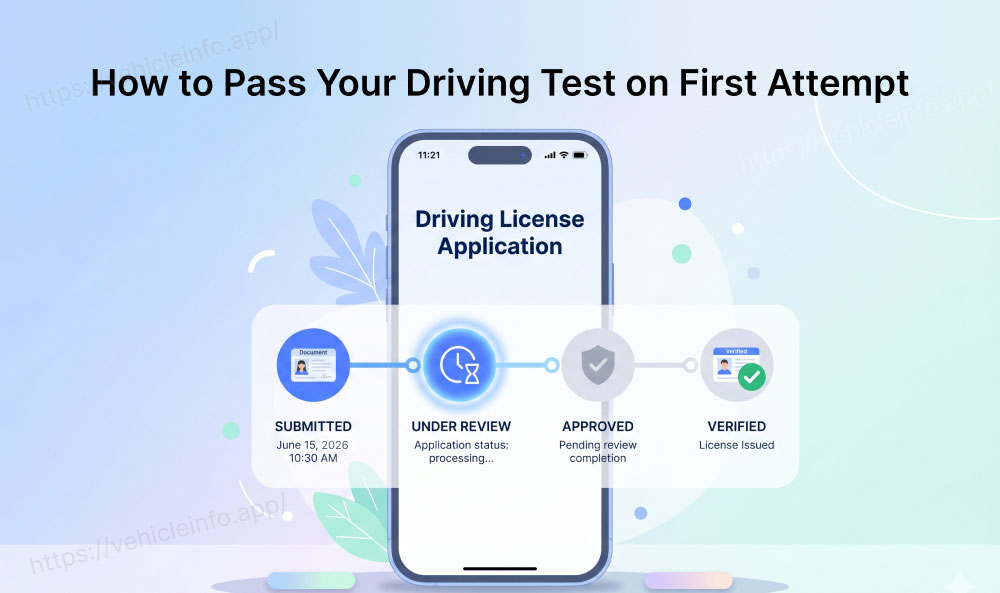
Document verification first. Before you get anywhere near a vehicle, an RTO officer will check your documents. Carry your original Learner's Licence, application acknowledgement, and one photo ID. If you are still preparing for your licence journey reviewing the complete DL application step-by-step process can help you understand everything from Learner’s Licence application to final DL issuance.
Waiting and batch assignment. Tests are conducted in batches, not individually. You will be assigned a queue number and called when your batch is ready. Waiting can range from 20 minutes to over an hour at busy RTOs, particularly in cities. Arrive early and bring patience.
The test itself. Depending on your RTO, you will either take an automated driving test on a designated test track or a manual driving test with an examiner. A growing number of RTOs across Delhi, Karnataka, Maharashtra, Tamil Nadu, and Gujarat now use automated test tracks. If your RTO has one, the automated system evaluates you , not a person.
Result announcement.You can also check driving licence status online after your test. Automated track results are immediate. Manual examiner results may take a few hours to appear on the portal.
Understanding the structure removes the shock factor. Your driving test tips journey starts with knowing the terrain.
Automated Test Track , All Manoeuvres Explained
The automated driving test is the format most people are least prepared for, simply because it is newer and less described online. Sensors embedded in the track evaluate whether you completed each manoeuvre correctly, whether you crossed boundary lines, and whether you obeyed speed limits and signals. Here is every manoeuvre on an automated driving test track, with tips for each.
Straight Driving
The first and most basic section involves driving in a straight line within lane markings for a designated distance. While it sounds simple, candidates often lose points here by:
- Drifting toward the kerb or centre line
- Driving too fast and braking abruptly at the end point
- Not checking mirrors before starting
DL test tips for straight driving: Keep your hands steady at the 9-and-3 or 10-and-2 position. Look far ahead rather than at the bonnet. Maintain a consistent speed , 20 to 30 km/h is typical for test tracks. Do not oversteer.
Gradient/Slope (Hill Start)
This manoeuvre tests your ability to start the vehicle on an incline without rolling backwards. It is one of the most common automated driving test fail reasons because candidates either stall the engine or roll back more than the allowed 30 cm.
Automated driving test tips for the slope: In a manual car, use the handbrake-release technique , release the clutch until you feel the vehicle resist, then release the handbrake and apply throttle simultaneously. In an automatic, simply release the brake and apply gentle throttle. Stay calm, the slope is not steep, but the sensors detect even minor rollbacks precisely.
Reverse Parking
The vehicle must be reversed into a marked bay accurately. Sensors detect whether you have parked within the boundary and whether you hit any obstacle markers.
Driving test parking tips: Begin by positioning your car parallel to the bay entry, about 1 metre away from the bay's outer edge. Watch your rear camera or mirrors. Aim the rear corner of the car toward the far inner corner of the bay. Straighten before the front clears the bay entry. Take your time , there is no bonus for speed here.
Parallel Parking
You are required to park parallel to a kerb between two marked boundary points. The sensors check whether your vehicle is within the designated length, whether you have crossed into the oncoming lane, and how many steering corrections you made.
Driving test tips for parallel parking: Turn sharply after your rear passes the front boundary marker. Count your rotations and counter-steer at the right moment. Avoid touching the kerb sensor markers. Practice this specific manoeuvre before your test , it is the one with the highest failure rate.
8-Figure
The 8-figure (figure-of-eight) manoeuvre tests your steering control, smooth turning radius management, and spatial awareness. You must drive the vehicle in a figure-8 pattern within cones or sensor boundaries without touching or crossing them.
Driving test tips for the 8-figure: Low speed is your friend here. Maintain 5 to 10 km/h throughout. Look ahead to where you are going, not at the cones beside you. Wide, smooth steering inputs beat jerky corrections every time.
S-Curve
The S-curve requires navigating a tight, S-shaped path without crossing the boundary markers. It tests vehicle control in consecutive opposite-direction turns.
DL test tips for the S-curve: Reduce speed significantly before entering. Keep your hands positioned for quick counter-steering after the first curve. Do not brake sharply mid-curve , release the throttle instead. Smooth, progressive steering through each arc is what sensors reward.
Manual Test, What the Examiner Looks For
At RTOs without automated tracks, a licensed examiner accompanies you in the vehicle or observes from the kerb. What examiners check in DL test evaluations includes:
Smooth vehicle operation. Stalling, jerky acceleration, or grinding gears are marked down immediately. Smooth clutch and throttle coordination is expected from the first metre.
Mirror usage. Check your rear-view and side mirrors before every manoeuvre. Examiners specifically watch for this. Many candidates forget mirrors entirely when nervous.
Proper signals. Indicate before turning, changing lanes, or pulling over. Forget to signal once and it is noted.
Speed management. Driving too fast for the test area, or creeping along without confidence, both register as problems. Steady, appropriately paced driving reads as competence.
Lane discipline. Staying in the correct lane, not crossing centre lines, and positioning correctly for turns are all evaluated.
Parking. The examiner will ask you to park , either parallel park to the kerb or reverse into a space. This is where most manual test candidates lose marks.
Overall vehicle control. Emergency stops, turning radius accuracy, and how you handle junctions without signals all contribute to the assessment.
Top 10 Reasons People Fail the Driving Test (And How to Avoid Them)
Understanding DL test fail reasons is arguably the most practical driving test preparation you can do.
1. Rolling back on the slope. The most common automated test failure. Practise the hill start until it is automatic.
2. Crossing boundary lines during parking. Both parallel and reverse parking require precision within centimetres on automated tracks. Measure your practice sessions accurately.
3. Not checking mirrors before starting. Examiners and sensors both flag this omission consistently.
4. Stalling the engine mid-manoeuvre. Happens when nervousness causes clutch mismanagement. Take a breath before each section and focus on smooth pedal work.
5. Touching or hitting cone markers. One contact with a marker is typically an automatic disqualification on automated tracks. Slow down.
6. Incomplete signalling. Using indicators incorrectly or forgetting them is one of the most common manual test fail reasons.
7. Braking too harshly. Sudden braking during tests registers as poor vehicle control. Anticipate stops and brake progressively.
8. Driving too slowly or too hesitantly. Excessive caution reads as a lack of competence. Steady, confident pacing is the goal.
9. Wrong gear selection. Driving in second gear on a straight or grinding into first from third stands out immediately to an examiner.
10. Nerves causing rushing. Trying to complete manoeuvres faster than needed leads to overshooting marks and losing control. Every test section has adequate time allocated.
Pre-Test Preparation Checklist
These RTO driving test tips apply in the days before your test:
One week before:
- Practice all automated track manoeuvres, especially the slope and parallel parking
- Do at least 2 to 3 full driving sessions including the manoeuvres in sequence
- Review road signs and basic traffic rules in case you are asked by an examiner
Two days before:
- Organise all your documents in a folder: LL, acknowledgement, ID proof
- DL test slot booking online process Confirm your test slot time and RTO address
- Check whether your RTO provides a vehicle or requires you to bring one
The evening before:
- Avoid last-minute intensive practice, physical and mental rest matters
- Set an alarm that gives you comfortable time to reach the RTO before your slot
On the morning:
- Eat a proper breakfast , low blood sugar amplifies test anxiety
- Arrive at the RTO at least 20 to 30 minutes before your slot time
- Park your test vehicle (if you are bringing one) where directed
What to Bring on Test Day
A missed document means being turned away and re-booking. Bring the following:
Mandatory for all applicants:
- Original Learner's Licence card
- Application acknowledgement printout (or clearly visible on phone)
- One original photo ID (Aadhaar, Voter ID, or Passport)
If bringing your own test vehicle:
- Vehicle Registration Certificate (RC)
- Valid vehicle insurance
- Valid PUC (Pollution Under Control) certificate
- A passenger with a valid driving licence (since this is mandated by law if you hold a learner licence)
For transport/HMV DL applicants:
- Training completion certificate
- Form 1A medical certificate signed by a registered doctor
- Educational qualification certificate (Class 8 pass)
Optional but useful:
- A pen for any forms to fill at the counter
- Water bottle , waiting can take over an hour at busy RTOs
What If You Fail? The Retest Process
Failing the driving test is not the end of the road. Here is what happens and how the retest process works:
Automated track failure: The system records which specific manoeuvre(s) caused the failure. This information is invaluable, it tells you exactly what to practise.
Manual test failure: The examiner's notes will indicate the reasons. Ask the officer at the licensing counter for clarification on what was assessed.
Retest eligibility: You can rebook your test after 7 days from the date of failure. The retest booking follows the same process as the original, log in to parivahan.gov.in, go to DL Services, and select Schedule Test.
Retest fee: A nominal re-test fee applies (approximately ₹50 to ₹150 depending on your state). There is no limit on how many times you can attempt the test, provided your LL remains valid.
If LL expires before you pass: You will need to apply for a fresh Learner's Licence and restart the waiting period. This is why keeping your retest attempts within the LL validity window (180 days from issue) matters.
FAQs
1. What are the most common reasons for failing the driving test in India?
Ans: Rolling back on the slope, touching boundary markers during parking, not checking mirrors, and stalling the engine are the top automated driving test fail reasons. In manual tests, incorrect signalling and poor gear selection account for most failures.
2. How to pass the automated driving test if I have only practised on regular roads?
Ans: The automated track manoeuvres are very specific. Practising on open roads alone is not sufficient preparation. If possible, find out which test track layout your RTO uses and practise those specific manoeuvres , particularly the hill start, reverse parking, and parallel parking.
3. How many attempts are allowed before the LL expires?
Ans: There is no limit on attempts within your LL validity period (180 days). Each reattempt requires a new booking and a re-test fee payment.
4. What happens if I fail the DL test twice?
Ans: Nothing additional happens. You simply rebook and pay the re-test fee again. Your LL continues to be valid for the remaining duration. Use each failure as feedback on exactly what to improve.
5. Can I use an automatic vehicle for the driving test?
Ans: Yes, but check with your specific RTO. Some automated test tracks are configured only for manual transmission vehicles. If you use an automatic vehicle, your DL may carry an automatic-only restriction in some states.
6. Is there a way to reduce driving test anxiety?
Ans: Familiarity reduces anxiety more than anything else. Visit the RTO before your test day to see the layout. Practice until each manoeuvre is a reflex, not a thought process. On test day, take three slow breaths before starting each section. The test is designed to be passable , it is not designed to trip you up.