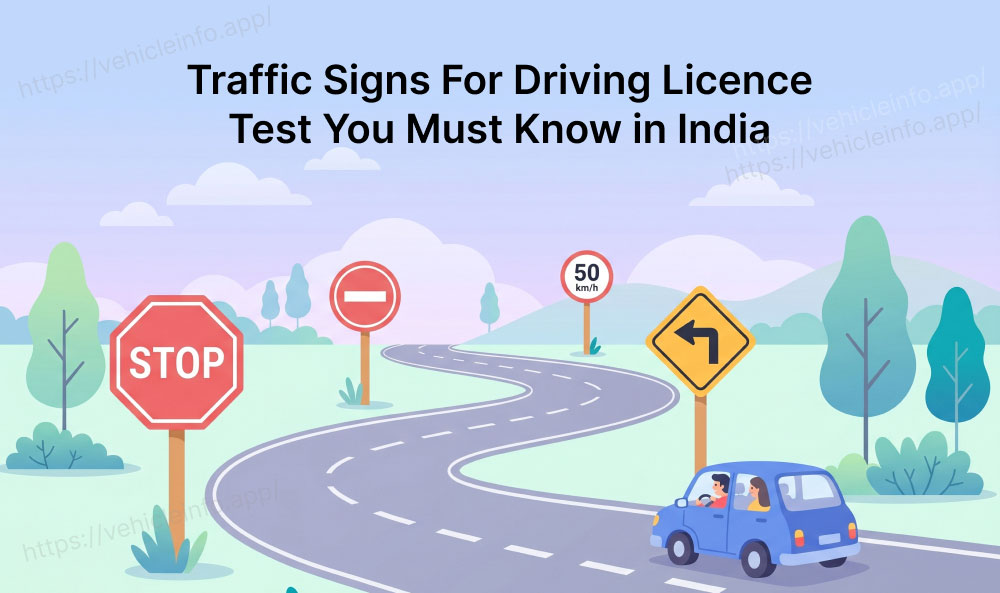
Traffic Signs For Driving Licence Test You Must Know in India
04 May, 2026
The Learner's Licence theory test in India asks about 15 to 20 questions, and a significant chunk of them, often 6 to 10 questions, are typically about traffic signs. These are not trick questions. They are questions that are designed to test whether you can identify what a road sign means and whether or not you would be able to respond to it correctly while driving. Getting this section right is entirely about preparation, and this guide gives you exactly what you need: the 20 most tested traffic signs for driving licence test with clear meanings, study tips, and sample multiple-choice questions in the format the actual DL test uses.
Traffic Signs in the DL Theory Test: What to Expect
The LL theory test is computer-based and conducted at your state RTO on the day of your booked test slot. The test interface displays traffic sign images with multiple-choice answers and situational questions about what to do when you see a particular sign, along with some general road rule questions. You can easily schedule this test in advance if you book your driving licence test slot online through Parivahan Sewa.
DL Test Format across most states:
The DL test format remains the same across most states, with only a little variation in the type and form of questions for some particular states. The common format of the LL Test includes:
- 15 to 20 questions in total
- 10 to 15 minutes to complete the test
- A Passing score of 60% minimum (varies by state)
- Test language: English or other regional language (your choice at the test terminal)
For the section of traffic signs for driving licence test in India, questions come in two common formats:
- Image-based: These are questions that seek an answer based on an image and four textual choices. For example, 'What does this sign mean?'
- Scenario-based: These are questions that seek an answer based on a driving scenario with action-based choices. For example, 'You see a Stop sign ahead. What should you do?'
Preparing for both formats means knowing not just what each sign looks like, but what the correct response to it is.
Top 20 Most-Tested Traffic Signs For Driving Licence Test in India
While there is a mixed bag of traffic signs for driving licence test in India, a few signs are often more popular than others. These are the signs that appear most frequently in DL theory test questions across states. Mastering these road signs for DL exam India will help you handle the exam with ease and confidence.
1. Stop Sign
Shape: Red octagon
Meaning: You must bring the vehicle to a complete stop before the stop line. Proceed only when the way is clear.
2. No Entry
Shape: Red circle with white horizontal bar
Meaning: No vehicles may enter from this direction. Commonly seen on one-way streets.
3. Give Way
Shape: Red inverted triangle
Meaning: Yield the right of way to vehicles on the intersecting road. You may proceed without stopping if the way is clear, but must give way if there is traffic.
4. Speed Limit Sign
Shape: Red circle with a number inside
Meaning: Maximum speed in km/h permitted on that road. Common test values include 30, 40, 50, and 80 km/h. Do not exceed this speed.
5. No Overtaking
Shape: Red circle with two cars (one behind the other, with a cross)
Meaning: Overtaking or passing other moving vehicles is prohibited in this zone.
6. No Parking
Shape: Red circle with a blue P and a diagonal red line
Meaning: Parking is not permitted in this zone at any time.
7. No Stopping or Standing
Shape: Red circle with a blue tow truck symbol
Meaning: Stricter than no parking because here, even temporarily stopping is not allowed.
8. Pedestrian Crossing
Shape: Yellow diamond or white rectangle with pedestrian symbol
Meaning: A pedestrian crossing is ahead. Slow down and be prepared to stop for pedestrians.
9. School Zone Ahead
Shape: Yellow diamond with children walking symbol
Meaning: A school zone is ahead. Slow down and watch for children crossing.
10. Narrow Road Ahead
Shape: Yellow diamond or white rectangle with converging lines.
Meaning: The road narrows ahead. Reduce speed and be prepared to give way.
11. Slippery Road
Shape: Yellow diamond with swerving car symbol
Meaning: The road surface is slippery. Reduce speed, avoid sudden braking or sharp steering.
12. Sharp Bend (Left or Right)
Shape: Yellow diamond with a curved arrow.
Meaning: A sharp curve in the indicated direction is ahead. Reduce speed before entering the bend.
13. Hump or Speed Breaker Ahead
Shape: Yellow diamond with a bump symbol.
Meaning: A speed breaker is ahead. Reduce speed.
14. Steep Descent Ahead
Shape: Yellow diamond with downward slope symbol.
Meaning: A steep downhill section is ahead. Engage a lower gear if in a manual vehicle; avoid heavy braking mid-slope.
15. Crossroads Ahead
Shape: Yellow diamond with a plus (+) symbol.
Meaning: An uncontrolled intersection is ahead. Slow down and proceed cautiously.
16. One Way
Shape: White rectangle with a black arrow pointing in one direction.
Meaning: Traffic flows only in the direction of the arrow. Entering from the opposite direction is a violation.
17. Keep Left
Shape: Blue circle with a left-leaning arrow.
Meaning: Vehicles must keep to the left of the divider or obstruction ahead.
18. Hospital Zone
Shape: White or blue sign with a red cross or 'H'.
Meaning: A hospital is nearby. Honking prohibited; maintain low speed and quiet operation.
19. No Honking Zone
Shape: Red circle with a horn symbol crossed out.
Meaning: Using the horn is not permitted. Common near hospitals, schools, and court buildings.
20. Railway Level Crossing (Unmanned)
Shape: Yellow diamond with a steam engine symbol and 'X'.
Meaning: An unmanned railway crossing is ahead. Stop, look both ways, and proceed only when safe. Do not rely on signals, as there may be none.
Mandatory DL Test Traffic Signs You Must Know
Mandatory traffic signs in India use a red circle as their primary shape. These signs convey prohibitions and obligations as well as things you must do or must not do.
Key mandatory signs for the DL test that you must know to ace the DL exam include:
- Stop: Red octagon (an exception to the circle rule, the only octagonal road sign in India)
- Speed Limit: Red circle with number
- No Entry: Red circle, white bar
- No Overtaking: Red circle, two cars with a cross
- Compulsory Ahead: Blue circle with white arrow pointing straight
- Keep Left: Blue circle with left arrow
- Compulsory Turn: Blue circle with appropriate directional arrow
Memory trick: Red circle = something is prohibited or compulsory. Blue circle = something is positively required.
Cautionary DL Test Traffic Signs You Must Know
Cautionary (warning) traffic signs in India typically use a yellow diamond shape (or white diamond in some older installations). These signs warn of road conditions or hazards ahead on the route.
Key cautionary signs for the DL test that you must know to crack the DL exam include:
- Slippery road ahead
- School children ahead
- Pedestrian crossing ahead
- Sharp bend ahead
- Narrow road ahead
- Hump or speed breaker ahead
- Steep descent ahead
- Crossroads ahead
- T-junction ahead
- Loose gravel or road repair ahead
Memory trick: Yellow diamond = a hazard or caution condition lies ahead. Slow down and prepare.
Understanding these warning signs is crucial but you should also learn practical RTO driving test tips to pass on your first attempt especially for real-road scenarios.
Informatory DL Test Traffic Signs You Must Know
Informatory signs provide guidance and information about nearby areas of utility, such as hospitals, fuel stations, and parking areas. These traffic signs use a blue or green rectangular format and are commonly asked during an LL test.
Key informatory signs for DL test in India include:
- Hospital (red cross or ‘H’ on blue or white background)
- Parking permitted (blue 'P')
- First aid post
- Fuel/petrol pump ahead
- Rest area ahead
- Direction and distance markers
For DL theory test MCQ on traffic signs, informatory sign questions typically ask you to identify what the sign indicates or what action it requires (or permits). Once you pass your test you can easily download your driving licence online without visiting the RTO.
Quick Tips to Memorise Traffic Signs
Memorising traffic signs can seem tricky at first, especially with so many symbols to remember. But with a few simple tricks, it becomes much easier over time. Small habits like noticing signs on the road or linking them to everyday examples can help you ace the DL exam in India. This section shares some easy ways to remember common DL Test Traffic Signs without stress.
Use shape as a category filter first
Before reading the sign, identify its shape.
- Red octagon = stop.
- Red circle = prohibition or obligation.
- Yellow diamond = caution.
- Blue rectangle = information.
This helps eliminate wrong answers immediately, leaving you with either the correct answer or two potentially correct answers to choose from.
Pair the symbol with an action, not just a meaning
Do not just memorise traffic signs in a way that relates only to what it means, for example, slippery road = wet surface. Memorise traffic signs in a way that you can relate them to what they imply. For example, slippery road = reduce speed, avoid sudden braking, and no sharp steering. This will help you answer faster, better and more accurately.
Practice with image flashcards
The DL test shows images and not text descriptions. Therefore, practising with the actual sign images (available on the MoRTH website and the Sarthi4 portal's mock test section) is more effective than reading text descriptions alone.
Group similar signs together
Since there are a lot of traffic signs to master when attempting a DL test in India, it is always better to learn all traffic signs of the same category together. For better and more efficient preparation, it is advised to learn all no-entry-type prohibition signs together, all speed-related signs together, and all pedestrian/school zone signs together. Grouped learning helps reduce confusion during the test.
Attempt the mock test on the Sarathi portal
The official mock test available at parivahan.gov.in mirrors the actual test format and includes all traffic sign images. Complete at least two mock tests before your LL test appointment.
Sample Questions from the LL/DL Theory Test
To help you ace the LL theory test, here are some representative MCQ formats used in the DL test theory questions on traffic signs:
Q1: You see a red octagonal sign at an intersection. What should you do?
A) Slow down and proceed cautiously
B) Honk to warn other vehicles and proceed
C) Come to a complete stop before the stop line and proceed only when clear
D) Yield to oncoming traffic
Correct answer: C
Q2: A yellow diamond-shaped sign with a curved arrow is displayed on the road. What does it indicate?
A) A roundabout ahead
B) A sharp bend ahead, reduce speed
C) A U-turn is permitted here
D) Road narrows to one lane
Correct answer: B
Q3: Which of the following sign shapes indicates a mandatory action that must be followed?
A) Yellow diamond
B) Green rectangle
C) Red circle
D) White triangle
Correct answer: C
Q4: You are approaching a sign showing two children walking. What is the most appropriate action?
A) Maintain current speed but honk to alert children
B) Overtake slowly to clear the zone quickly
C) Slow down significantly and be prepared to stop
D) Switch on hazard lights and continue at normal speed
Correct answer: C
Q5: A blue circular sign with a white arrow pointing to the left is displayed. What does it indicate?
A) You must turn left at the next junction
B) A left lane is available for slower vehicles
C) You must keep to the left and not cross to the right
D) Left turn is permitted but not required
Correct answer: C
Q6: You see a sign with a red circle containing a car overtaking another car, with a cross over it. What does this mean?
A) Slow lane for cars on the left
B) No overtaking permitted in this section
C) Two-lane road ahead
D) Keep two car lengths between vehicles
Correct answer: B
FAQs
1. Which traffic signs are asked in the DL test?
Ans: The LL and DL theory test draws primarily from mandatory signs (prohibitions), cautionary signs (hazard warnings), and a selection of informatory signs. The 20 signs in this guide cover the vast majority of what appears in actual test questions across states.
2. How many traffic signs are in the DL exam?
Ans: Out of 15 to 20 total test questions, typically 6 to 10 questions relate directly to traffic signs, either identifying a sign's meaning or choosing the correct driving response to a sign.
3. Where can I get official DL test traffic sign study material?
Ans: The Sarathi portal at parivahan.gov.in has a free mock test section that includes traffic sign questions with images. The MoRTH publication Motor Driving: A Practical Guide is available at RTOs and contains all official sign illustrations.
4. Are the traffic signs tested in regional language exams the same as English ones?
Ans: Yes. The signs themselves are visual and language-independent. The question text and answer choices are translated, but the sign images are identical regardless of the language chosen for the test.