Virtual Court for Traffic Challans: How to Pay Without a Court Visit
03 June, 2026
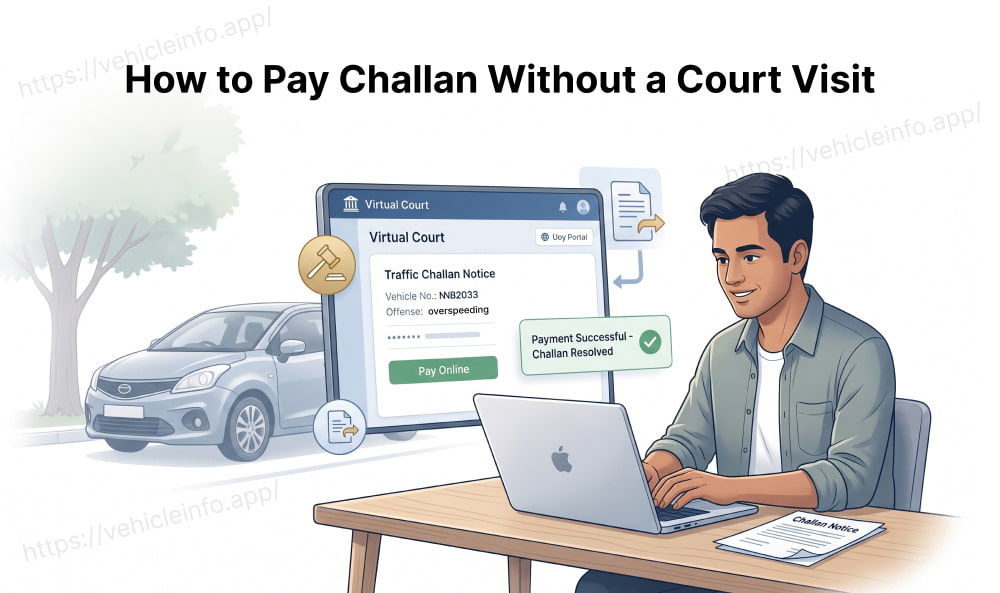
Most traffic fines in India can be paid directly on the Parivahan portal or through apps like Vehicle Info without any court involvement. But some challans, particularly older unpaid ones, get referred to traffic court for adjudication. When that happens, you receive a court summons and must pay challan without the court becoming an option, only if you use the virtual court system. A virtual court echallan case lets you resolve the matter online without setting foot in a courtroom.
This guide explains how to pay challan without court intervention, how the virtual court challan process works, which violations qualify, and how it compares to the standard online payment route.
What Exactly is Virtual Court for Traffic Challans?
Virtual court is an online judicial platform developed under the supervision of the Supreme Court of India's e-Committee. Rather than physically appearing before a magistrate for a minor traffic violation, you log in to the virtual court portal, review the case details, and choose to either pay the prescribed fine online or contest the challan.
A case in virtual court is typically created when:
- A challan remains unpaid beyond a set threshold period
- The violation is serious enough to warrant judicial oversight
- The traffic authority refers a batch of pending challans to the court for processing
Once referred, the vehicle owner receives an SMS or notice with a virtual court case number. This is different from a regular unpaid challan, which you can still pay directly on Parivahan. If you have received a court notice, the virtual court traffic fine route is the correct channel. Paying on Parivahan at this stage will not close the court case.
How the Virtual Court System Works
The virtual court system operates through official judicial portals. Delhi's virtual court at vcourts.gov.in is the most developed and widely used in India, handling thousands of traffic cases every month. The system has since been expanded to courts in several other states.
When your virtual court echallan case is created, you receive an SMS with a reference number. Log in to the relevant virtual court portal, enter this reference number, and you will see the case details, including the original violation, the prescribed fine amount, and the options available to you. This is how to pay challan in virtual court: you do not attend a hearing, you simply log in and settle the fine online through the virtual court payment process.
You have two primary choices in the virtual court payment process:
Party Peshi (appearing online): You accept the fine amount and pay it online to close the case. This is the most common choice for straightforward traffic violations where you do not intend to contest the challan.
Contesting the case: If you believe the challan was issued incorrectly, you can flag this in the virtual court system, after which the case may be referred to a physical hearing with a magistrate. This path takes longer and requires documentation.
For most drivers, the party peshi vs virtual court comparison favours paying online, since the fine is usually the same as the original amount and settling it closes the matter permanently.
Which Violations Qualify for Virtual Court?
Not every traffic challan goes to virtual court. Virtual court challan eligible violations are typically minor to moderate offences under the Motor Vehicles Act where the traffic authority chooses to refer the case rather than allow indefinite non-payment.
Common virtual court challan eligible violations include:
- Overspeeding
- Signal jumping
- Mobile phone use while driving
- Not wearing a helmet or seatbelt
- Driving without a valid licence or insurance documents
More serious offences involving injury, drunk driving with aggravated circumstances, or repeat offenders may be sent to physical court rather than the virtual court system. Challans that are still in the regular payment window (visible on Parivahan and unpaid) are not yet in virtual court territory; only those formally referred by traffic authorities reach the virtual court traffic fine stage.
Step-by-Step: How to Pay Your Virtual Court Challan Online
Here is how to complete the online court challan payment process once you have received a virtual court notice.
Step 1: Find the right portal. Delhi virtual court cases are handled at vcourts.gov.in. For other states, the portal is usually accessible through the state's High Court or District Court website, or through the National Judicial Data Grid.
Step 2: Log in with your case or reference number. Use the number from the SMS or physical notice you received. If you cannot find it, you can search by vehicle number on the portal.
Step 3: Review the case details. Check the violation type, fine amount, and the options available. Most virtual court challan cases offer the party peshi option for straightforward payment.
Step 4: Choose party peshi and pay. Select the online payment option and complete the transaction using UPI, debit card, or net banking. Save the court receipt, which serves as official proof that the matter has been settled.
Step 5: Confirm case closure. After payment, the virtual court system should mark the case as disposed. Confirm this by logging back in after 24 to 48 hours.
Cities and States Where Virtual Court is Available
The Delhi virtual court system (vcourts.gov.in) is the most fully developed and widely used in India. Delhi processes hundreds of thousands of traffic challan cases through virtual court each year.
Beyond Delhi, virtual court for traffic challans is available in parts of Maharashtra, Rajasthan, Haryana, and several other states, though the level of implementation varies. If you have received a summons from outside Delhi, check the relevant state's High Court website or the National Judicial Data Grid (njdg.ecourts.gov.in) to find the correct portal for your jurisdiction.
Expansion of the virtual court system to all states is ongoing. If you are wondering which challans can be paid via virtual court in your area, or if virtual court available in my city is a question you have searched, the answer depends on your state's implementation. Cities in Delhi, parts of Maharashtra, Rajasthan, and Haryana currently have functional systems. Check the National Judicial Data Grid (njdg.ecourts.gov.in) to find your jurisdiction's portal. If virtual court is not yet available in your city, unpaid challans referred to court must be resolved through a physical appearance.
Virtual Court vs Physical Court vs Direct Payment: Which Applies to You?
| Scenario | Best Route |
|---|---|
| Challan is recent, visible on Parivahan, and unpaid | Pay directly on Parivahan, Vehicle Info, or UPI app |
| Challan is old but still showing on Parivahan | Pay via Parivahan or Vehicle Info before it is referred to court |
| Challan has been referred to virtual court | Use vcourts.gov.in or state equivalent |
| Challan referred to physical court | Attend in person or hire legal representation |
The simplest situation to be in is the first one. An unpaid challan that is still on Parivahan can be cleared in minutes using Vehicle Info or the Parivahan portal. Once referred to the virtual court, the process has an extra step. Once referred to a physical court, it becomes considerably more time-consuming.
FAQs
1. What is virtual court for traffic challans?
Ans: Virtual court is an online judicial platform where minor traffic cases can be resolved without appearing before a magistrate in person. When an unpaid challan is referred to court, the vehicle owner receives a notice with a virtual court case number. They can then log in, review the case, and pay the prescribed fine online through the party peshi option to close the matter without visiting a courthouse.
2. How do I pay my virtual court traffic fine online?
Ans: To understand how to pay challan in virtual court, visit vcourts.gov.in for Delhi cases or your state's equivalent portal. Enter your case or reference number, select party peshi, and pay using UPI, debit card, or net banking. Save the court receipt as proof. To check if virtual court available in my city is a current option, visit njdg.ecourts.gov.in for your jurisdiction. The online court challan payment typically reflects as case-disposed within 24 to 48 hours.
3. Which challans can be paid via virtual court?
Ans: Virtual court challan eligible violations include minor offences such as overspeeding, signal jumping, helmet non-compliance, seatbelt violations, and mobile phone use while driving. Not every challan becomes a virtual court e-challan case. The traffic authority decides which unpaid challans to refer. If your challan is still visible on Parivahan as unpaid, you can still pay it there directly without going through the virtual court at all.
4. Is Delhi virtual court available to all vehicle owners?
Ans: Yes, the Delhi virtual court system at vcourts.gov.in is available to any vehicle owner whose challan has been referred to the Delhi courts. You do not need to be a Delhi resident. If your vehicle received a challan in Delhi that has been referred to virtual court, you can log in from anywhere in India and complete the party peshi vs virtual court payment process online.
5. What is party peshi in virtual court?
Ans: Party peshi means choosing to appear as a party and pay the fine online to close the virtual court challan case without a physical hearing. In the virtual court system, selecting party peshi takes you to a payment screen where you can clear the prescribed fine amount. It is the standard option for most traffic violations and is how the majority of virtual court cases are resolved quickly and without additional legal steps.
6. What happens if I ignore a virtual court notice?
Ans: Ignoring a notice from virtual court escalates the matter further within the judicial system. The court may issue a warrant or summons requiring your physical appearance, which makes the situation significantly harder to resolve. The virtual court payment process exists specifically to give vehicle owners a simple and quick option before enforcement steps are taken. Paying through party peshi is almost always the faster and easier resolution.