Is Car Insurance Mandatory in India? Law, Penalty and What Counts as Valid Cover
24 June, 2026
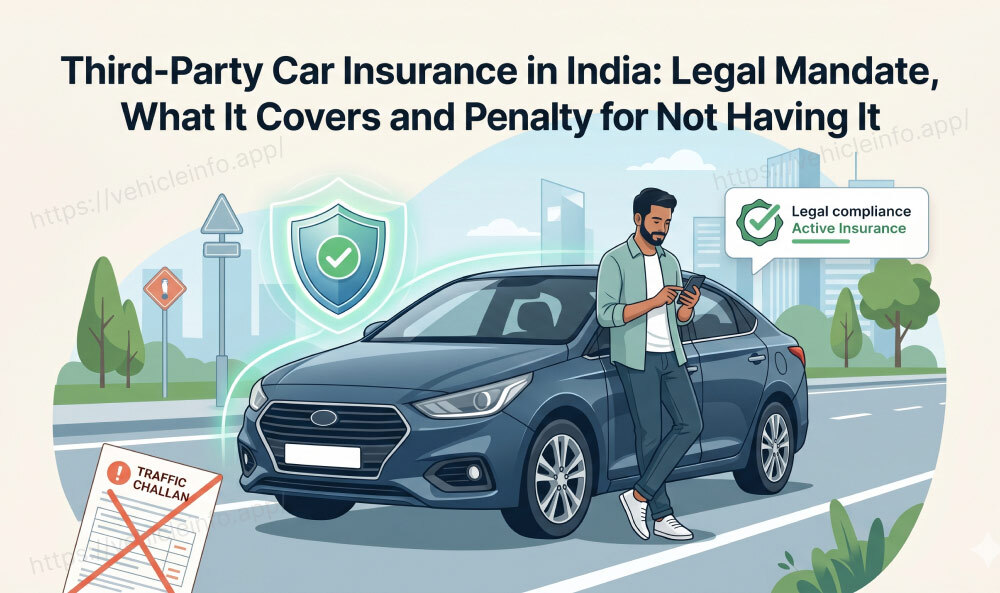
Many owners ask: is car insurance mandatory in India? The legal answer is a firm yes, and the rule is not optional, conditional, or open to interpretation. Section 146 of the Motor Vehicles Act 1988 states plainly that no car can be driven in a public place without a valid insurance policy covering third-party risk. The moment your car moves onto a road used by the public, the law requires active cover. Break that rule, and you face a fine, possible imprisonment, and full personal liability for any harm your car causes.
This single law sits behind the most-searched car insurance question in the country. Owners want to know whether they truly need cover, what kind counts as valid, and what happens if they get caught without it. The answers are fixed in statute, and they carry real financial weight. A policy that costs a few thousand rupees a year stands between you and a compensation bill that could run into lakhs. The mandate, however, is narrower than it sounds, and understanding it precisely is the difference between staying compliant and unknowingly driving illegally.
The Legal Mandate: Section 146 of the Motor Vehicles Act 1988
The duty to insure flows from a single, clear provision. Section 146 of the Motor Vehicles Act car insurance framework prohibits the use of any motor vehicle in a public place unless a valid policy covering third-party risk is in force. There is no exemption for old cars, rarely driven cars, or cars used only on quiet roads. If the car is used in a public place, cover is compulsory.
This is the legal answer to those wondering is car insurance mandatory in India. The provision is a flat prohibition and not a recommendation. It applies to the owner who allows the car to be driven as much as to the person behind the wheel. Both can be penalised if the car runs without valid cover.
The purpose behind the rule is protective rather than punitive. Before this law existed, accident victims were often left with nothing because the at-fault owner had no money to pay. By making cover compulsory, the State guarantees a source of compensation for any victim, regardless of the owner's personal wealth. That is why car insurance mandatory status is treated as a matter of public protection, and why the courts enforce it strictly.
What Type of Car Insurance Is Legally Required?
Here is where most owners misread the law. The car insurance legal requirement india sets is for third-party cover only. The law does not force you to insure your own car against damage. It forces you to insure against the harm your car may cause to others.
This distinction matters in practice and in your wallet. Third party car insurance mandatory status is the legal floor. Comprehensive cover, which also protects your own car, is optional. You stay fully compliant with third-party cover alone, even though comprehensive is wiser for valuable or financed cars.
| Cover Type | Legally Required | Protects Others | Protects Your Own Car |
|---|---|---|---|
| Third-Party | Yes, mandatory | Yes | No |
| Comprehensive | No, optional | Yes | Yes |
| Own Damage Only | No, and not valid alone | No | Yes |
Third-party cover satisfies the car insurance legal requirement in India. A comprehensive cover also satisfies it, because it contains the third-party portion inside it. A standalone own-damage policy without third-party cover, however, does not offer legal compliance because it skips the part the law cares about. So the answer to is it compulsory to have car insurance in India is a definitive yes for a third-party cover, and no for the rest.
What Third-Party Insurance Covers
Since third party car insurance mandatory cover is what the law demands, it is crucial to know exactly what it pays for. The cover is defined by Section 147 of the Motor Vehicles Act and protects other people from harm your car causes.
It covers three things:
- Death or bodily injury to a third party, where the liability is unlimited and decided by the Motor Accident Claims Tribunal.
- Damage to a third party's property, up to a cap of Rs 7.5 lakh.
- The legal costs of defending a claim, with the insurer's consent.
What it does not cover is your own car, your own injuries beyond the separate owner-driver personal accident cover, theft, fire, or natural events. This narrow scope is the trade-off for the low, regulator-fixed price. The Motor Vehicles Act car insurance mandate exists to protect victims, not your vehicle. So while third-party cover keeps you legal and shields you from a crippling compensation claim, it leaves your own car exposed. That gap is exactly what comprehensive cover fills for those who choose it.
Penalty for Driving a Car Without Insurance
The penalty for no car insurance is set by Section 196 of the Motor Vehicles Act, and the 2019 amendment raised it sharply to push compliance. The fine is the visible cost, but it is not the worst one.
| Offence | Penalty |
|---|---|
| First offence | Up to 3 months imprisonment, or a fine of Rs 2,000, or both |
| Repeat offence | Up to 3 months imprisonment, or a fine of Rs 4,000, or both |
First Offence
For a first offence, the penalty for driving without car insurance in India is a fine of up to Rs 2,000, or imprisonment of up to three months, or both. This applies to both the driver and the owner who allowed the uninsured car to be driven.
Repeat Offence
A second or subsequent offence carries a stiffer penalty for no car insurance: a fine of up to Rs 4,000, or up to three months' imprisonment, or both. The escalation is deliberate, designed to deter owners who treat the first fine as a minor cost.
Seizure of Vehicle
Beyond the fine, enforcement authorities can take further action. In some cases, an uninsured vehicle may be detained or seized at a checkpoint until the owner regularises the cover. The far bigger risk is civil liability. If your uninsured car injures or kills someone, you personally pay the entire compensation the tribunal awards, which can be many lakhs. This is what happens if you drive without car insurance in the worst case, and it dwarfs any traffic fine.
How Does a Traffic Personnel Verify Insurance at Checkpoints?
Roadside checks have gone digital, and paper documents are no longer the main test. A traffic officer now verifies your cover through the national database rather than by inspecting your glovebox.
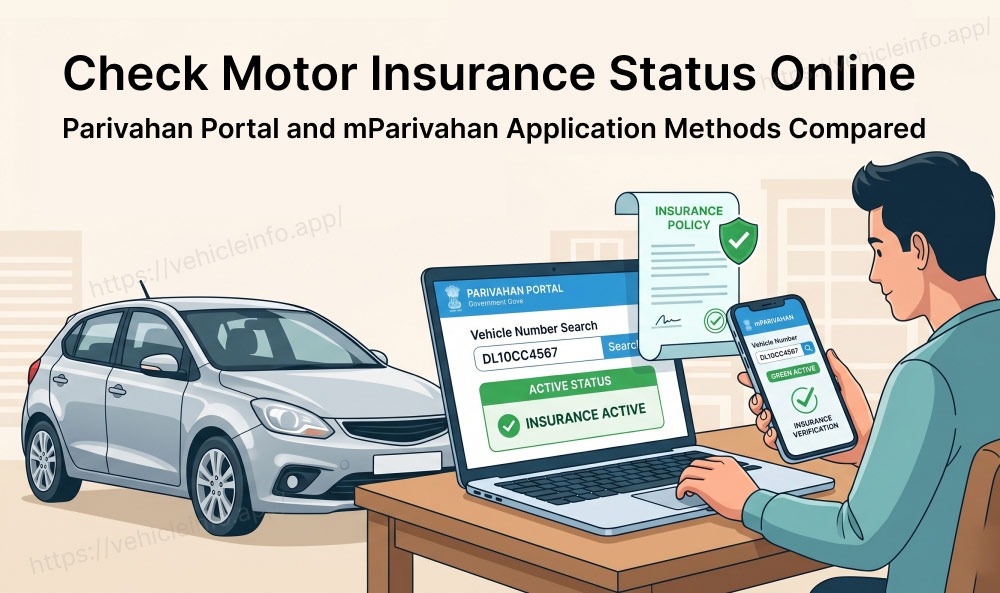
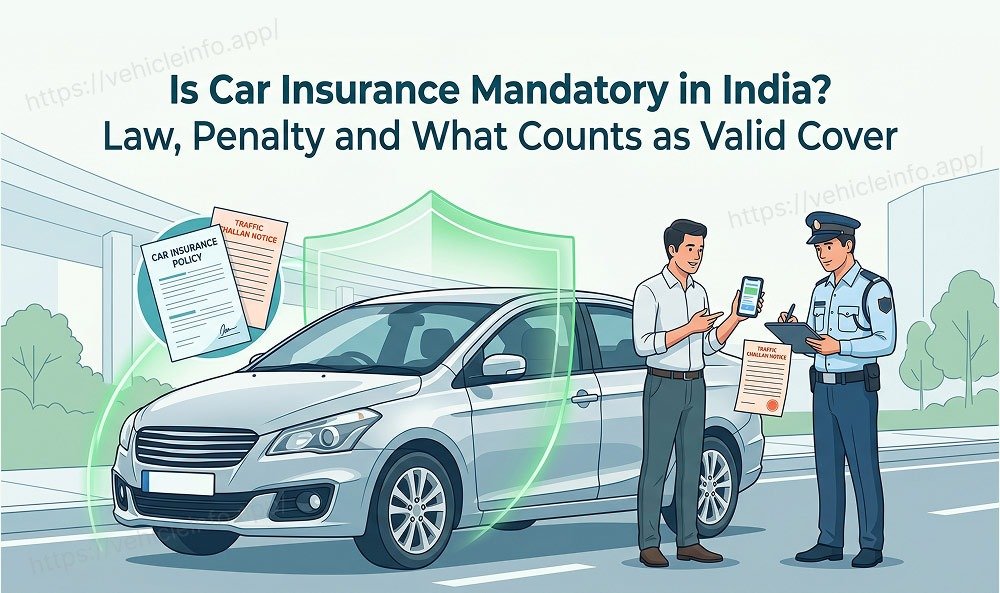
At a checkpoint, the officer enters your registration number into the mParivahan app or a state enforcement app. The app pulls your vehicle's record, including insurance validity, from the central Parivahan database. If the record shows valid cover, you pass. If it shows a lapse, the officer can issue a challan on the spot. A digital copy of your policy stored in the mParivahan app or DigiLocker is accepted as valid proof, so you no longer need to carry physical papers.
The practical lesson is that your insurance must actually be active in the database, not merely paid for. The officer trusts the system. This is why owners who let cover lapse get caught even when they believe they are fine, and why a clean digital record is your real protection at a checkpoint.
E-Challan and No-Insurance Fines: How the System Works
Enforcement no longer needs an officer to be present. Traffic cameras feed into linked databases that can flag an uninsured vehicle automatically and generate a challan without a physical stop.
When a camera captures your car, the system can cross-check your registration number against insurance records. If those records show no valid cover, an e-challan can be raised and sent to the registered owner. So you can be penalised for an insurance gap you thought no one noticed, simply because the database showed a lapse when the camera read your plate.
This digital link between cameras, the central database, and the challan system is why an expired policy is dangerous even if you rarely drive. The system does not forget and does not need a checkpoint to act. Keeping cover continuously active is the only reliable way to stay clear of an automated no-insurance fine.
Does a Lapsed Policy Count as No Insurance?
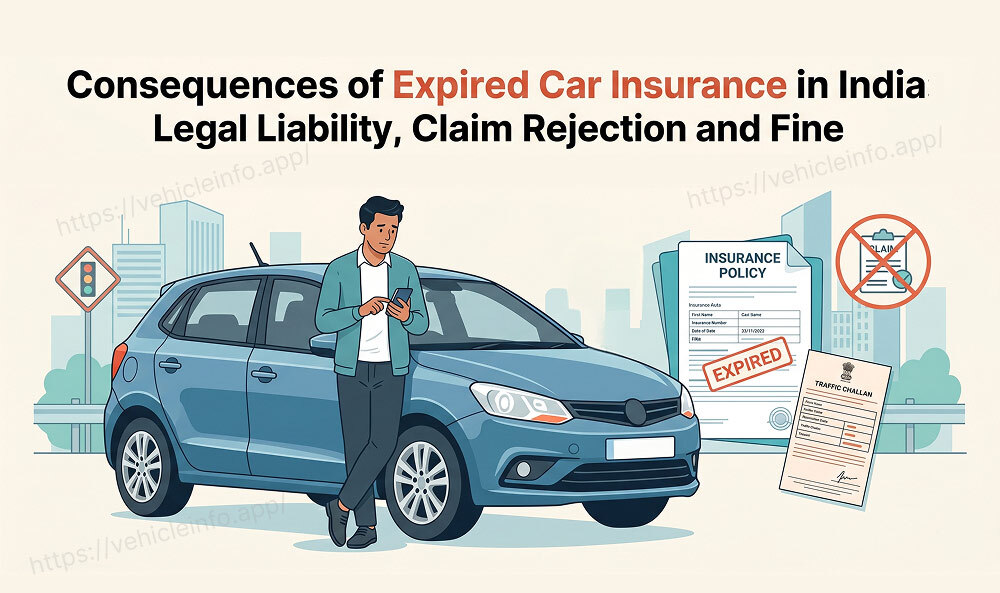
Yes. A lapsed policy is the same as no policy in the eyes of the law. The moment your cover expires, you are driving uninsured, and every consequence of having no insurance applies in full.
There is no grace period that keeps you legally covered after expiry. People often confuse the 90-day window for retaining the No Claim Bonus with a grace period for cover. They are not the same. During a lapse, your car is uninsured, you are exposed to the Section 196 penalty, and any accident leaves you personally liable. The 90-day window only protects your future discount, not your present cover.
This is why renewal timing matters so much. Renew before the expiry date, never after. A policy that expired yesterday offers exactly as much legal protection as no policy at all, which is none.
When Comprehensive Cover Does Not Satisfy the Legal Minimum
Comprehensive cover usually keeps you legal because it contains the mandatory third-party portion. But there is a trap. If the third-party component of a policy has lapsed or is not validly in force, the cover does not satisfy the law, no matter how much own-damage protection it carries.
The legal test is narrow. Enforcement checks whether valid third-party cover exists, not whether you also have own-damage protection. So a policy that has expired, or one bought without the required third-party element, fails the test even if it once protected your car. This is why an active, in-force third-party component is the part that actually matters for compliance.
The takeaway is simple. Comprehensive cover is a fine choice and keeps you legal while it is valid, but it is the third-party portion inside it that discharges your duty. Let the policy lapse, and the comprehensive label gives you no legal protection at all.
IRDAI's Role in Setting Mandatory Third-Party Premium Rates
While the Motor Vehicles Act creates the duty to insure, the Insurance Regulatory and Development Authority of India, in collaboration with the MoRTH, controls the price of the mandatory cover. The regulator fixes the base third-party premium each financial year, which is why the rate is identical across every insurer for the same car.
The premium depends on engine capacity. The indicative base annual rates for private cars are around Rs 2,094 for cars up to 1000cc, Rs 3,416 for cars between 1000cc and 1500cc, and Rs 7,897 for cars above 1500cc, with GST added on top. Because the regulator sets these rates, no insurer can charge more or less for the mandatory third-party portion. There is no point in shopping around for the price of this part alone.
This regulation keeps the legal minimum affordable for everyone, which supports compliance. Insurers compete only on the optional own-damage cover, never on the regulated third-party rate. Understanding this helps you spot a fair quote and avoid being overcharged on the part that the law forces you to buy.
State-Level Enforcement and Court Procedures
The insurance mandate is national, but enforcement happens at the state level through traffic police and the courts. Each state's police use the central database to verify coverage, and prosecutions under Section 196 run through the magistrate courts.
When an officer issues a challan for no insurance, the matter can be settled through the fine or contested in court if you dispute it. Where an accident is involved, a separate process runs through the Motor Accident Claims Tribunal, which decides compensation for the victim. The tribunal can order your insurer to pay, or, if you were uninsured, hold you personally liable for the full award.
This division of roles is worth understanding. The police enforce the document requirement, the magistrate courts handle the penalty, and the tribunal handles compensation. An uninsured owner can face all three at once after a serious accident.
How to Renew to Stay Legally Compliant
Staying compliant comes down to one habit: renewing before the expiry date. Cover must be continuous, because any gap, however short, makes you uninsured under the law.
Set a reminder ahead of your renewal date, since no one sends a legal notice before your cover ends. Renew online directly with your insurer to avoid a lapse, and keep a digital copy of the new policy in the mParivahan app or DigiLocker, so you have valid proof at a checkpoint. After renewal, check your status on the Parivahan portal, remembering that a new policy can take a few weeks to appear, so carry your document in the meantime.
If you have already let the cover lapse, renew immediately, but expect the insurer to require a vehicle inspection before issuing a fresh policy. A lapse of even a day can trigger this re-inspection. The cleanest path is never to let it lapse at all, which keeps you legal, protects your No Claim Bonus, and avoids the inspection delay entirely.
Frequently Asked Questions
1. Is car insurance mandatory in India?
Ans: Yes. The answer to is car insurance mandatory in India is a firm yes by virtue of Section 146 of the Motor Vehicles Act. Every car used in a public place must carry valid third-party cover, regardless of its age or how often it is driven.
2. Is it compulsory to have car insurance in India?
Ans: Yes, for third-party cover. The question is it compulsory to have car insurance in India is settled by the Motor Vehicles Act car insurance rules. Third-party cover is compulsory, while comprehensive cover is optional and protects your own car.
3. What type of car insurance is legally required?
Ans: Only third-party cover. The car insurance legal requirement india has set is for third party car insurance mandatory protection. Comprehensive cover also satisfies the law because it includes the third-party portion, but a standalone own-damage policy does not.
4. What is the penalty for driving without car insurance in India?
Ans: The penalty for driving without car insurance in India under Section 196 is up to Rs 2,000 or three months' imprisonment for a first offence, and up to Rs 4,000 for a repeat offence. Both the driver and the owner can be penalised.
5. What happens if you drive without car insurance?
Ans: What happens if you drive without car insurance is a fine, possible imprisonment, and full personal liability for any harm your car causes. An accident while uninsured can leave you paying lakhs in compensation with no insurer to absorb it.
6. Does a lapsed policy count as no insurance?
Ans: Yes. A lapsed policy is treated as no insurance, so the full penalty for no car insurance applies. There is no grace period for cover after expiry. The 90-day window only protects your No Claim Bonus, not your legal cover.
7. Does comprehensive cover keep me legal?
Ans: Yes, while it is valid, because it contains the mandatory third-party portion. But if the policy lapses, the comprehensive label gives no legal protection. Only an active, in-force third party car insurance mandatory component satisfies the law.
8. How do police verify insurance at checkpoints?
Ans: Officers enter your registration number into the mParivahan app, which pulls your insurance validity from the central Parivahan database. If the record shows a lapse, you can be fined on the spot. A digital policy copy is accepted as valid proof.
9. Can I get an e-challan for no insurance without being stopped?
Ans: Yes. Cameras feed the central database, which can flag an uninsured vehicle and raise an e-challan automatically. This is part of what happens if you drive without car insurance when the system reads your plate and finds no valid cover.
10. Who sets the mandatory third-party premium?
Ans: The Insurance Regulatory and Development Authority of India fixes the base third-party rate each year. Because of this, the price of the legally required cover is the same across all insurers, with rates based on your car's engine capacity.
11. Is car insurance mandatory for an old car?
Ans: Yes. Car insurance mandatory status does not depend on the car's age. Any car used in a public place needs valid third-party cover under the Motor Vehicles Act car insurance rules, whether it is brand new or decades old.
12. How do I stay legally compliant?
Ans: Renew before the expiry date so your cover never lapses. Keep a digital copy as proof, and check your status on Parivahan after renewal.