Vehicle Insurance Rules and Legal Requirements in India: Complete Compliance Guide
24 June, 2026
Owning a vehicle in India comes with one rule you just cannot skip. Your vehicle must carry valid insurance before it hits the road, following the strict vehicle insurance rules in India. This is not a suggestion or a recommendation from an insurer trying to sell you a policy. It is the law, written clearly into the Motor Vehicles Act and enforced by the police, the RTO, and the digital VAHAN system every single day.
Although drivers understand they require an auto insurance policy, they are often unaware of the rules put in place regarding vehicle insurance. The majority of drivers do not understand which types of insurance coverages are mandated by law, which ones are optional, how a lapse in your auto insurance policy may lead to an e-challan showing up in your account and enforcement measures taken against you after an e-challan is issued. To aid you in understanding your obligations as a vehicle owner under the law, this document serves as a resource by providing clear, concise information regarding the vehicle insurance legal obligations under applicable laws, identifying the section of applicable law pertaining to each legal obligation and providing information regarding enforcement practices with respect to e-challans.
Most drivers know they need a policy, but very few understand the actual vehicle insurance rules India has put in place. They do not know which cover the law forces them to buy, which cover is optional, what happens when a policy lapses, or how an e-challan can land in their account because of an insurance gap. This guide fixes that. We explain the vehicle insurance legal requirements in plain language, point to the exact sections of law, and show you how enforcement works on the ground. Read on to understand the rules surrounding vehicle insurance in India to stay compliant, avoid penalties, and know your rights when a traffic officer stops you.
Is Vehicle Insurance Mandatory in India? The Legal Answer
Vehicle insurance is mandatory in India for every motor vehicle used in a public place. There is no exception based on how old the vehicle is, how rarely you drive it, or whether it sits parked most of the year. The moment a vehicle hits a public road, the law requires an active insurance policy covering third-party risk.
For those wondering, is vehicle insurance mandatory before you take a car or bike out? The simple answer is yes, and that mandate comes directly from the Motor Vehicles Act insurance framework, specifically Chapter 11 of the Act, which deals with insurance of motor vehicles against third-party risks. The rule is simple. No valid policy means no legal right to drive.
People often confuse the type of cover that is mandatory. The law does not force you to insure your own vehicle against damage. It forces you to insure against the harm your vehicle may cause to others. That distinction sits at the heart of every vehicle insurance rule in the country, and we explain it fully below:
Prior to the mandatory TP policy law being enacted, many people who suffered injury as a result of motor vehicle accidents were left with nothing due to the fact that the owner of the vehicle didn't have enough money to compensate them for their injuries.
Many times, those who were injured or lost family members due to motor vehicle accidents received nothing at all as a result.
The current vehicle insurance requirements were established to ensure there are funds available for compensation in such cases.
By requiring that all vehicle owners acquire insurance, the State has ensured that there will always be a fund available to provide compensation to victims, regardless of the financial means of the owner of the offending vehicle.
As a result of the social purpose behind the creation of the insurance mandate, the courts impose heavy fines for violations of the requirement.
There is no minimum usage threshold to the law either. Some owners believe that a vehicle driven only occasionally, or only on quiet roads, escapes the rule. It does not. The test in law is whether the vehicle is used in a public place, not how often or how far it travels. A single trip on a public road without cover is enough to make you non-compliant. This is why the safest approach is to keep cover active at all times rather than trying to judge when the rule applies.
Motor Vehicles Act 1988: Insurance Provisions You Must Know
The Motor Vehicles Act 1988 is the parent law that governs how vehicles operate on Indian roads. Its insurance chapter answers the question of what are the legal requirements for vehicle insurance in India. Three parts of this law matter most to vehicle owners, and understanding them removes almost all confusion around compliance.
Section 146
Section 146 is the rule that makes insurance compulsory. It states that no person shall use, or allow another person to use, a motor vehicle in a public place unless a valid policy covering third-party risk is in force. This is the legal heart of the entire system. The Motor Vehicles Act 1988 insurance provisions begin here, and every penalty flows from a breach of this section.
The purpose of Section 146 is preventive. The law wants financial protection to exist before an accident happens, not after. By making third-party cover compulsory, the State ensures that an accident victim has someone to claim compensation from, even if the vehicle owner has no money of their own.
Section 147
Section 147 explains what a valid policy must actually contain. A policy that does not meet these requirements is not legally valid, even if you paid for it. Under this section, the policy must cover liability for death or bodily injury caused to a third party and damage caused to third-party property. This is why vehicle insurance, mandatory under Indian law, always means third-party cover at a minimum.
Section 147 also fixes the limits of liability. For death or bodily injury to a third party, the liability is unlimited and decided by the courts. For third-party property damage, the cover is capped, a figure we cover in the third-party section later in this guide.
Third-Party as the Legal Minimum
The main rule established by Sections 146 and 147 is that third-party liability insurance is the lowest amount of insurance that you may carry on your vehicle and is used to provide coverage for damages to others' property or injuries to other people resulting from an accident while your vehicle is being operated. There is no coverage for your vehicle itself.
This is the most essential fact concerning compliance with the law. You can legally operate your vehicle if you have third-party liability coverage. You will not, however, be able to legally operate your vehicle without insurance. All other types of insurance products available in the market are above this minimum standard and are only required by choice, not by law.
IRDAI Regulations: The Rules That Govern Your Policy
While the Motor Vehicles Act creates the duty to insure, the Insurance Regulatory and Development Authority of India controls how the insurance itself works. IRDAI vehicle insurance regulation covers pricing, claim rules, deductibles, and the design of every motor policy sold in the country.
IRDAI sets the base third-party premium rates each financial year, which is why these rates are identical across every insurer. No company can charge you more or less than the notified third-party rate for your vehicle category. Additionally, IRDAI is also tasked with fixing important policy terms. The standard deductible is set at Rs 1,000 for cars up to 1500cc and Rs 2,000 for cars above 1500cc. The regulator also recommends passenger cover of at least Rs 25,000 and has set the owner-driver personal accident cover at Rs 15 lakh.
These IRDAI vehicle insurance rules protect you as a buyer. They make sure the mandatory cover stays affordable and standard, while leaving the optional covers open to competition between insurers. When you understand that the law forces the cover and IRDAI controls the terms, the whole system starts to make sense.
The way claims are handled by the regulator is also important to the buyer, as it is one way to ensure proper treatment of a policyholder (e.g., the use of a time limit for appointing claim surveyors and providing claim payout). The IRDAI has specified timelines for appointing surveyors and for decisions regarding claims; this prevents insurers from delaying payout for an indefinite period of time. The IRDAI has also created standardised No Claim Bonus (NCB) grids across all insurers, meaning an individual will have a smooth transition of the NCB earned from the previous insurer if one chooses to switch to a new insurer. IRDAI has also required that all vehicle insurance (automotive liability) policies have a QR code placed on the policy document, making for easy verification of the policy document in case of a roadside inspection. All of the above measures are designed by the IRDAI to promote market conduct and maintain fairness towards the consumer/insured.
One more point matters for compliance. Because IRDAI fixes the third-party premium, no agent can pressure you into a higher mandatory price. If someone quotes a third-party rate above the notified figure for your vehicle category, you are being overcharged. The own-damage portion of a comprehensive policy is where insurers compete on price, not the third-party portion. Knowing this protects your wallet and helps you spot a fair quote.
Types of Cover: What the Law Requires vs What You Choose
Indian motor insurance comes in two broad types. The law touches only one of them. Knowing which is which keeps you both compliant and protected.
| Type of Cover | Required by Law | What It Protects | Who Chooses It |
|---|---|---|---|
| Third-Party Liability | Yes, mandatory | Other people, their vehicles and property | The State requires it |
| Comprehensive | No, optional | Your own vehicle plus third-party liability | You choose to buy it |
| Own Damage Only | No, optional | Only your own vehicle | You choose to buy it |
Third-party cover is the floor set by law. Comprehensive cover on the other hand adds protection for your own vehicle against theft, fire, accident, and natural events, but the law never forces you to buy it. Many owners assume comprehensive is compulsory because dealers sell it at the time of purchase. It is not. While it is a sensible choice, it is not a legal duty. If your vehicle is valuable or financed through a loan, comprehensive cover is wise. If your vehicle is old and worth little, you may legally choose third-party cover alone. The decision is yours, as long as the mandatory third-party portion stays active.
Mandatory Third-Party vs Optional Comprehensive: The Legal Distinction
There are stark legal differences between these two types of insurance, and they should be clearly defined. Third party insurance satisfies your legal liability to other parties under the Motor Vehicles Act, while comprehensive insurance does not have any legal requirement at all, as it is simply a product that contains the mandatory third party element.
This means a comprehensive policy also makes you compliant, because it contains the third-party coverage the law demands. But a pure own-damage policy without third-party cover would not make you compliant, because it skips the part the law cares about. When you buy comprehensive, you are buying the legal minimum plus extra protection in a single package.
For enforcement purposes, the police and the VAHAN system only check whether a valid third-party cover exists. They do not check whether you also have own-damage protection. A traffic officer cannot fine you for skipping comprehensive cover. They can, however, fine you for having no third-party cover. These are the insurance rules RTO and police actually enforce.
Penalty for Driving Without Insurance in India
The vehicle insurance penalty for driving without cover is set by Section 196 of the Motor Vehicles Act. The penalties were increased sharply by the 2019 amendment to push compliance up. Here is exactly what you face.
| Offence | Penalty |
|---|---|
| First offence | Up to 3 months imprisonment, or a fine of Rs 2,000, or both |
| Second or subsequent offence | Up to 3 months imprisonment, or a fine of Rs 4,000, or both |
The vehicle insurance penalty applies to both the driver and the owner who allows an uninsured vehicle to be driven. The fine is not the worst part. If your uninsured vehicle injures or kills someone, you personally pay the entire compensation the court awards, which can run into several lakhs of rupees. A policy costing a few thousand rupees protects you from a liability that could destroy your finances.
This is why the law treats driving without insurance as a serious offence rather than a minor lapse. The penalty exists to protect accident victims, not just to punish drivers.
Insurance Validity and What Happens When Your Policy Lapses
A policy is only useful while it is valid. The moment it expires, your legal cover ends, and you are back to being non-compliant. Insurance validity rules are strict, and a lapse creates problems beyond a simple fine.
When a policy lapses, three things happen at once. First, you are driving illegally and exposed to the Section 196 penalty. Second, you lose your No Claim Bonus if the gap runs beyond 90 days, which raises your future premium. Third, your insurer may require a fresh inspection of the vehicle before issuing a new policy, which delays your return to legal status.
The practical rule is simple. Renew before the expiry date, never after. Set a reminder, because no one sends a legal notice before your cover ends. A lapsed policy offers zero protection, which means an accident during the gap leaves you personally liable for everything.
Most owners do not realize the hidden costs associated with a lapse. A continuous renewal history keeps premiums lower and no claims bonuses intact. A lapse of greater than 90 days will cause the loss of the no claims bonus that has been built over time, resulting in much higher premiums when renewing. Therefore, there are two ways that a lapse can be harmful, the first is through financial liability and the second is through loss of discounts. The easiest way to remain compliant and financially beneficial is to treat renewals as a calendar event that requires timely action, not an afterthought.
How New Car Buyers Are Bound by Long-Term Insurance Rules
If you are buying a brand-new car, a special rule applies that older owners never faced. Following a Supreme Court direction, new private cars must carry a three-year third-party policy at the time of purchase, and new two-wheelers must carry a five-year policy. This rule took effect in September 2018 and changed how the motor vehicles act insurance mandate works for fresh registrations.
The reason behind this rule is practical. Many owners forget their first renewal, leaving new vehicles uninsured within a year of purchase. By bundling a long-term third-party cover into the sale, the law removed that risk for the early years of a vehicle's life. You can still buy a separate own-damage cover alongside the long-term third-party policy, which keeps the optional protection flexible while the mandatory part stays locked in.
For buyers, this means the dealer will arrange the long-term third-party cover as part of the purchase. You do not choose whether to have it. You only choose whether to add own-damage protection on top. Understanding this prevents confusion when you see a multi-year insurance entry on your new vehicle's paperwork.
E-Challan System and Its Link to Insurance Status
The e-challan system has changed traffic enforcement completely. Traffic cameras and the linked databases now detect violations without an officer being present, and insurance gaps are part of what gets flagged.
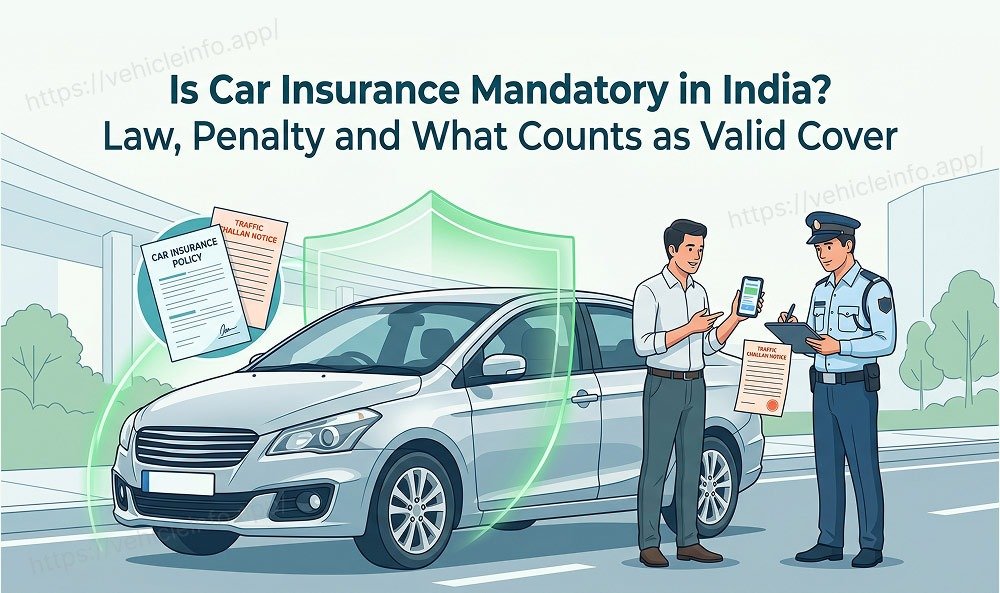
When a camera captures your vehicle, the system can cross-check your RC number against insurance records. If the records show no valid cover, an e-challan can be generated and sent to the registered owner. This means you can be penalised for an uninsured vehicle even when no police officer stopped you on the road.
Because of this digital connection between enforcement and insurance status, maintaining current insurance coverage is very important. The system does not rely on memory; it does not require an in-person inspection to perform, as it can only retrieve data from its records. If a policy has expired or would have been subject to enforcement action due to some insurance-related deferral event, this can trigger a fine, even if the policy remains in force after the date of the deferral was established.
RTO, VAHAN and Insurance Data Verification
The RTO, the VAHAN database, and your insurance records are now all connected. When you buy or renew a policy, the insurer reports it to the central system, and the VAHAN record updates to show your active cover.
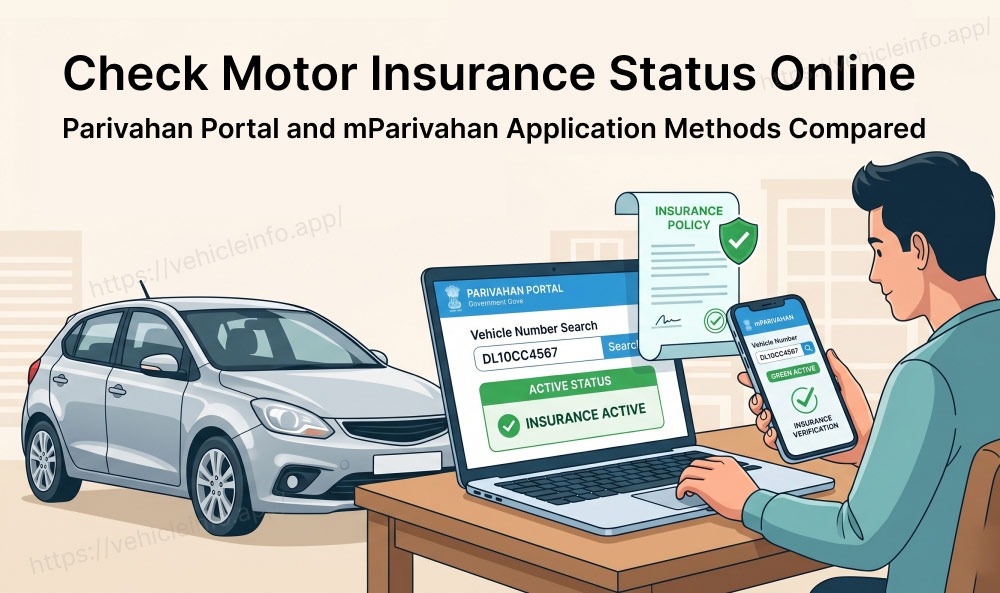
The RTO's linkage to an insurance company meets many objectives. At first, the RTO can verify an individual's or vehicle's insurance coverage during registration, transfer, and fitness processes using this link. Secondly, law enforcement officers can also use only a registration number to verify their insurance status at any time. You may use public lookup tools to check your own insurance coverage or that of a potential purchaser of your used vehicle. Everything the RTO can enforce as insurance rules depends on the accuracy of the insurance provider's database.
There is one practical caution. The database does not update instantly. A newly bought policy can take a few weeks to reflect in VAHAN. During this window, carry your policy document or its digital copy as proof, because the online record may still show a gap that no longer exists.
State-Level Enforcement: How Traffic Police Verify Insurance
Enforcement happens at the state level, even though the law is national. Traffic police across states now verify insurance digitally rather than by inspecting paper documents at the roadside. A typical check works like this:
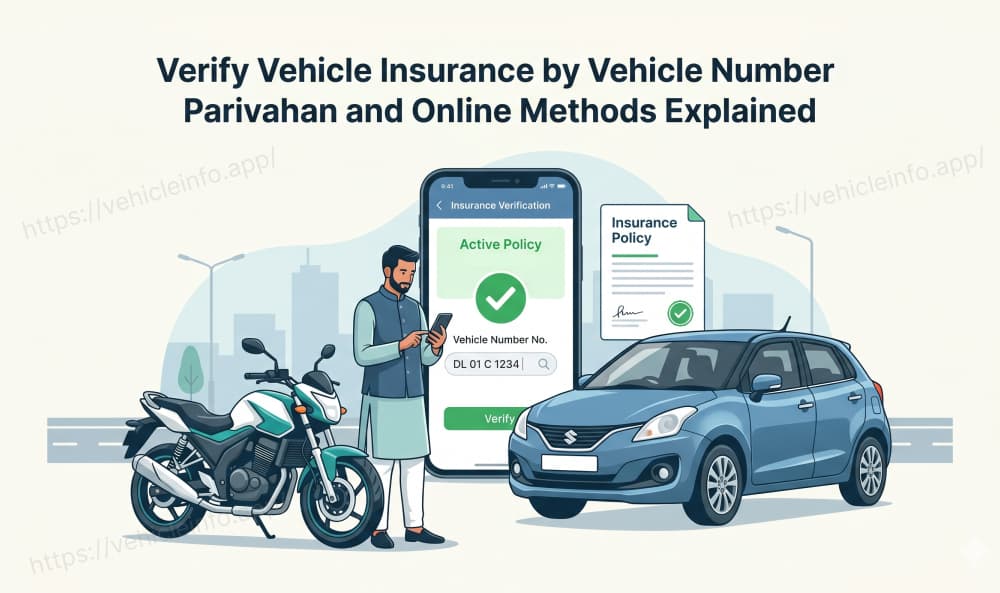
- The officer enters your registration number into the mParivahan app or a state enforcement app.
- The app pulls your vehicle record, including insurance validity, from the central database. If the record shows valid cover, you pass.
- If it shows a lapse, the officer can issue a challan on the spot.
- This is why a digital copy of your policy on the DigiLocker or mParivahan app is now accepted as valid proof.
The shift to digital verification means you no longer need to carry physical papers, but you do need your insurance to actually be active in the database. The officer trusts the system, not the paper. Keeping your record clean is the only reliable defence.
When Does Insurance Become Invalid Despite Being Paid For?
This is the rule that catches honest owners by surprise. You can pay for a policy and still find it invalid at the worst moment. A policy that is technically active can fail to protect you if certain conditions are broken.
Driving without a proper driver's license at the time of an accident, driving while under the influence of drugs or alcohol, using a private motor vehicle to provide commercial hire, and making a false statement about your insurance in order to purchase it are all common examples where coverage can be denied. If those terms are broken, the insurance company has grounds to deny your claim.
Even in instances where the insurance company has a legitimate reason to deny your claim, it is still required to pay third parties their damages first and seek the reimbursement from you. Therefore, while you do not have financial protection due to being in violation of the agreement, you still are financially responsible to the irresponsible driver causing damage to you. Just because you have what appears to be an active policy does not necessarily mean your claim will be valid. You must follow all provisions of your policy; otherwise, your policy is worthless when you need it.
Keeping Your Cover Active
Consider your vehicle insurance policy a contract with mutual responsibilities between you and your insurance provider. Your driving licence must remain valid and must be of the same category as the vehicle you are operating. You must never operate your vehicle under the influence of alcohol or drugs, and must only operate your vehicle for the use you have indicated to your insurer. All information provided when issuing an insurance policy must be truthful, and if there are any changes to your vehicle, the same must be duly intimated to the insurer.
Following these practices will not only keep your insurance policy alive but will also ensure that your insurance will be enforceable when a claim is made. The primary use of the motor vehicle insurance system created by the Motor Vehicle Act has been to protect motorists; this protection will only be available when all parties adhere to the provisions of the act.
Frequently Asked Questions
1. Is vehicle insurance mandatory for all vehicles in India?
Ans: Yes. Under the Motor Vehicles Act insurance rules, every vehicle used in a public place must carry valid third-party cover. For those wondering is a vehicle insurance mandatory, the answer is always a big yes, regardless of the vehicle's age or how often you drive it.
2. What are the legal requirements for vehicle insurance in India?
Ans: The legal requirement is a valid third-party policy that meets Section 147 conditions. This answers what are the legal requirements for vehicle insurance in India in one line. The policy must cover third-party death, injury, and property damage. Anything beyond that is optional.
3. Is comprehensive insurance required by law?
Ans: No. The vehicle insurance rules in India enforce only third-party cover. Comprehensive insurance is optional and protects your own vehicle. You stay legally compliant with third-party cover alone, though comprehensive is wiser for valuable or financed vehicles.
4. What is the penalty for driving without insurance?
Ans: The vehicle insurance penalty under Section 196 is up to Rs 2,000 or three months' imprisonment for a first offence, and up to Rs 4,000 for a repeat offence. Both the driver and the owner can be penalised.
5. How does the RTO verify my insurance?
Ans: The insurance rules RTO follow rely on the VAHAN database. When you buy or renew cover, the insurer reports it to the central system, and your record updates. The RTO and police check this record using your registration number.
6. What does IRDAI control in my policy?
Ans: IRDAI vehicle insurance regulation covers premium rates, deductibles, and policy terms. IRDAI sets the third-party premium each year, which is why the rate is the same across all insurers. The regulator also fixes deductibles and recommends minimum passenger cover.
7. Does an e-challan get linked to insurance status?
Ans: Yes. The e-challan system can cross-check your registration against insurance records. If no valid cover shows, a challan can be issued even without a physical stop. This is part of how vehicle insurance legal requirements are now enforced digitally.
8. Is vehicle insurance mandatory under Indian law for a parked vehicle?
Ans: A vehicle that never enters a public place technically falls outside Section 146. But the moment it moves on a public road, vehicle insurance mandatory under Indian law applies. In practice, keep cover active, because enforcement systems flag any registered vehicle without it.
9. What happens if my policy lapses?
Ans: A lapse makes you non-compliant and exposed to penalties. You may lose your No Claim Bonus after 90 days, and a fresh inspection may be needed. The Motor Vehicles Act 1988 insurance provisions offer no grace period, so renew before expiry.
10. Can my insurance be invalid even after I paid for it?
Ans: Yes. Cover can fail if you drive without a valid licence, drive drunk, misuse a private vehicle commercially, or hide facts when buying. The motor vehicles act insurance contract depends on these conditions being met.
11. Does third-party cover protect my own car?
Ans: No. Third-party cover protects only other people and their property. Your own vehicle is protected only under own-damage or comprehensive cover, which the vehicle insurance legal requirements do not force you to buy.
12. How long does a new policy take to show on VAHAN?
Ans: It can take a few weeks. During this gap, the insurance rules RTO enforce may show your record as uncovered. Carry your policy document as proof until the central database reflects your active cover.
13. Is third-party property damage cover unlimited?
Ans: No. Under Section 147 of the Motor Vehicles Act insurance rules, third-party property damage cover is capped. Death and bodily injury to a third party carry unlimited liability decided by the courts, but property damage has a fixed limit.
14. Can the police fine me for not having comprehensive cover?
Ans: No. The vehicle insurance penalty applies only to missing third-party cover. The IRDAI vehicle insurance framework treats comprehensive as optional, so the police cannot penalise you for choosing not to buy it.
15. Who enforces vehicle insurance rules in India?
Ans: Enforcement is shared. The Motor Vehicles Act insurance law is national, the IRDAI vehicle insurance regulation controls policy terms, and state traffic police plus the RTO handle on-ground checks through the VAHAN database. Together, they make the vehicle insurance rules India relies on work in practice.