Lok Adalat for Traffic Challans: How to Get Your Fines Waived or Reduced
04 June, 2026
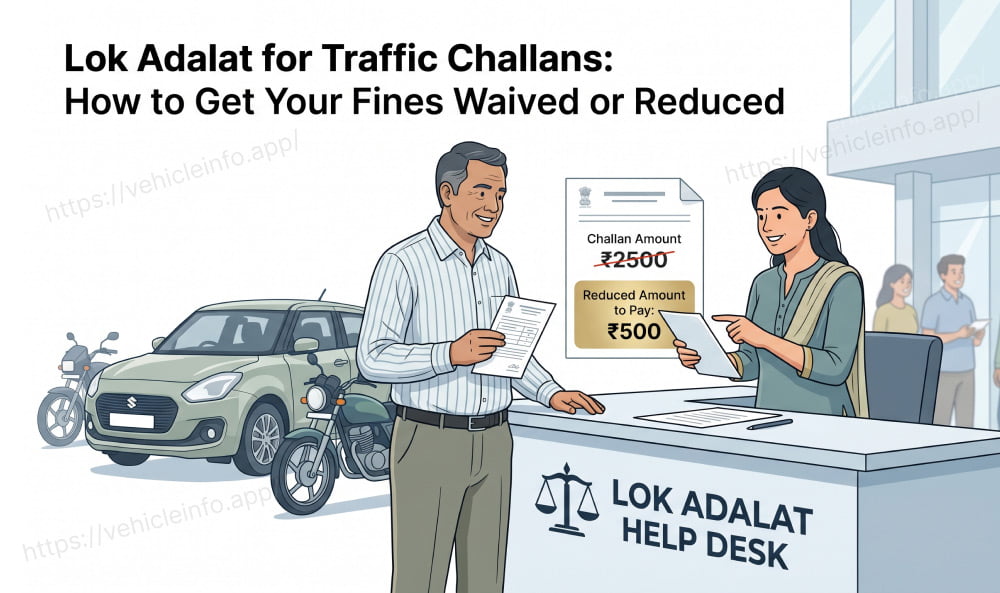
If you have a stack of unpaid traffic challans sitting on your Parivahan account, Lok Adalat might be the most practical solution you have not heard enough about. A lok adalat challan settlement lets you pay a fraction of the original fine amount, close the matter permanently, and avoid court proceedings altogether. Fine reductions of 50 to 75 per cent are common, and for very old challans, reductions of up to 90 per cent are not unusual.
This guide covers everything you need to know: how it works, which challans qualify, what the lok adalat waiver percentages typically look like, how traffic challan lok adalat sessions are structured, how to apply, when the sessions happen, and the specific process for Delhi, which has the most active challan settlement lok adalat programme in India.
What Lok Adalat Is and Why It Matters for Traffic Challans
Lok Adalat, which means "People's Court" in Hindi, is a form of alternative dispute resolution established under the Legal Services Authorities Act, 1987. It is not a regular court, and proceedings are informal and conciliatory. Traffic challan lok adalat cases are among the most common categories handled in these sessions, alongside motor accident claims and pre-litigation disputes.
The key feature that makes this settlement option attractive is finality. Once you accept the reduced fine and pay it during the session, the case is permanently closed. The matter cannot be reopened or appealed. It also does not create a criminal record or any adverse legal consequence, since the settlement is treated as a mutual agreement rather than a court verdict.
For vehicle owners with multiple old challans, a single Lok Adalat session can clear years of accumulated traffic fines at a fraction of the original total.
Which Traffic Challans Can Be Settled in Lok Adalat?
Lok adalat challan eligibility covers most minor to moderate traffic violations that have been referred to a traffic court or are at the stage of a court summons. The types of violations that qualify for challan settlement lok adalat typically include:
- Overspeeding
- Signal jumping
- Helmet and seatbelt non-compliance
- Use of mobile phone while driving
- Parking violations
- Driving without a valid licence or insurance documents
Very serious violations involving injury, drunk driving with aggravated circumstances, or cases where criminal proceedings have been initiated separately are generally not eligible for Lok Adalat settlement. Understanding which challans can be settled in lok adalat requires checking whether your specific case has been referred to court, as pre-court challans (those still on the Parivahan portal as regular outstanding fines) are typically paid directly rather than through Lok Adalat.
How Much of Your Fine Can Be Waived in Lok Adalat?
The lok adalat waiver amount depends on the age of the challan and the discretion of the presiding officer, but there are general patterns:
| Challan Age | Typical Waiver Percentage |
|---|---|
| Less than 1 year | 30 to 50 per cent |
| 1 to 3 years | 50 to 70 per cent |
| More than 3 years | 60 to 90 per cent |
The lok adalat traffic fine waiver is not a legally guaranteed percentage. It is negotiated at the session, and the presiding officer makes the final call. However, traffic police are generally motivated to settle old cases in bulk, which creates room for significant reductions. Challan reduced lok adalat outcomes of Rs 200 on an original Rs 1,000 fine are not uncommon for very old cases.
There is also an important principle at work: the lok adalat traffic fine waiver is a one-time opportunity. If you decline the offer at the session and the matter goes back to regular court, you lose the reduction and face the full fine amount plus potential court costs.
How to Apply and Participate in Lok Adalat for Traffic Challans
Lok adalat how to participate depends on whether the session is national or state-level, and whether your case has been pre-registered.
For National Lok Adalat sessions, the process typically works like this:
Step 1: Check whether your challan has been referred to court and pre-identified for the upcoming Lok Adalat session. Traffic authorities submit batches of old challan cases before each session. If yours is in the batch, you will receive an SMS or notice.
Step 2: Visit the District Legal Services Authority (DLSA) website or your state's High Court website to confirm the next lok adalat date for traffic challan cases in your district.
Step 3: Attend the session on the scheduled date with your challan details and documents. The lok adalat challan apply process at the venue involves presenting your case to the presiding bench, accepting the waived amount if offered, and paying on the spot.
Step 4: Collect the settlement receipt and court order. This is your permanent proof that the matter has been settled. The challan will be removed from the outstanding dues list within a few days.
For state-level Lok Adalat sessions, the process is similar but managed by the State Legal Services Authority rather than the national body.
When is the Next National Lok Adalat: Session Dates
National Lok Adalat sessions are held four times a year, typically in:
- Second Saturday of February or March
- Second Saturday of May or June
- Second Saturday of September
- Second Saturday of November or December
The exact national lok adalat challan dates for each year are announced by the National Legal Services Authority (NALSA) at nalsa.gov.in. State-level sessions are held more frequently and are managed by individual State Legal Services Authorities. Checking your state's DLSA website for the next lok adalat date for traffic challan sessions is the most reliable way to find upcoming dates in your city.
The Delhi Lok Adalat Challan Process: Tokens, Venues and What to Expect
Delhi has one of the most active lok adalat Delhi challan programmes in India. Thousands of challan cases are settled at each session, and the process is more structured than in most other states.
For lok adalat Delhi challan cases, the process works through a token system:
- Challans that have been referred to the Delhi courts are pre-registered for each Lok Adalat session
- Vehicle owners receive an SMS with a token number or can check their token status on vcourts.gov.in
- On the day of the session, you attend at the designated venue with your token, vehicle documents, and payment method
- The presiding officer reviews the case, offers a reduced fine, and completes the settlement on the spot
Delhi's Lok Adalat sessions for traffic challans are held at various district court complexes. The lok adalat Delhi challan process typically moves quickly because cases are pre-processed. Most participants complete their settlement within one to two hours.
Documents to Carry to Your Lok Adalat Session
Whether you are attending a national or state session, bring the following:
- Original challan receipt or challan number (printed from the Parivahan portal)
- Vehicle Registration Certificate
- Driving licence
- Vehicle insurance certificate
- A government-issued identity proof (Aadhaar, PAN, or Voter ID)
- Cash or a UPI-enabled phone for on-the-spot payment (most venues accept digital payment)
Having these documents ready speeds up the process considerably. The session cannot finalise your settlement without confirming your vehicle ownership and identity.
What Happens If You Miss the Lok Adalat Session?
If your case was pre-registered for a session and you did not attend, the matter returns to the regular court docket. You will not automatically be penalised for missing the session, but you lose the lok adalat waiver opportunity for that round.
Your case may be re-included in the next National Lok Adalat session if the traffic police submit it again. However, this is not guaranteed, and the reduction offered next time may be different. Do I need lawyer for lok adalat is a question many vehicle owners ask: the answer is no. Lok Adalat is specifically designed to be accessible without legal representation, and attending in person without a lawyer is standard practice and entirely sufficient for traffic challan cases. Do I need lawyer for lok adalat proceedings is therefore straightforward: you do not, and most people who attend do so independently.
The best approach remains to not miss your allocated session. Mark the date as soon as you receive the notice and prepare your documents in advance.
FAQs
1. What is Lok Adalat and how does it help with traffic challans?
Ans: Lok Adalat is a form of alternative dispute resolution under the Legal Services Authorities Act, 1987. A lok adalat challan settlement lets you pay a reduced fine, often 50 to 90 per cent lower than the original amount, to permanently close a traffic court case. Settlement is final and cannot be reopened. It is the most cost-effective way to clear old traffic challans that have been referred to court.
2. How do I get my challan waived in Lok Adalat?
Ans: To understand how to get challan waived in lok adalat, check whether your challan has been referred to court and pre-registered for an upcoming session. If it has, you will receive an SMS notice. Attend the session with your documents, accept the reduced fine offered by the presiding officer, and pay on the spot. How to get challan waived in lok adalat is essentially showing up and agreeing to the settlement amount offered.
3. Which challans can be settled in Lok Adalat?
Ans: Which challans can be settled in lok adalat depends on whether the case has been referred to traffic court. Minor violations such as overspeeding, signal jumping, helmet non-compliance, and parking offences are the most common traffic challan lok adalat eligibility categories. Cases involving serious injury, drunk driving with criminal charges, or matters at a contested court stage are generally not eligible. A challan settlement lok adalat outcome is only possible when the case is in the pre-conviction or summons stage of the court process.
4. When is the next Lok Adalat date for traffic challans?
Ans: The next lok adalat date for traffic challan sessions at the national level is typically held on the second Saturday of February, May, September, and December each year. Specific national lok adalat challan dates are announced by NALSA at nalsa.gov.in. State-level sessions are held more frequently. Visit your state's District Legal Services Authority website or your state's High Court website for upcoming dates specific to your city.
5. Do I need a lawyer for Lok Adalat?
Ans: No. Do I need lawyer for lok adalat is one of the most common questions, and the answer is no. Lok Adalat is specifically designed to be accessible without legal representation. You attend in person, the presiding officer reviews your case, and you agree to or decline the settlement amount. The lok adalat how to participate process does not require any legal filings or advocacy, making it straightforward for most vehicle owners.
6. How much can my traffic fine be reduced in Lok Adalat?
Ans: The lok adalat traffic fine waiver varies by challan age and the presiding officer's discretion. For challans less than one year old, reductions of 30 to 50 per cent are typical. For challans between one and three years old, reductions of 50 to 70 per cent are common. For very old challans, the challan reduced lok adalat outcome can be up to 90 per cent of the original amount. No reduction is legally guaranteed, but large reductions for old challan cases are the norm rather than the exception.
7. Can I apply for Lok Adalat online?
Ans: The lok adalat challan apply process is not fully online in most states. Cases are typically pre-registered by traffic authorities rather than by individual vehicle owners. However, Delhi vehicle owners can check their token status and lok adalat Delhi challan participation details at vcourts.gov.in. For other states, contact your District Legal Services Authority or check the DLSA website for the registration process in your area.
8. What if my challan is not yet referred to court? Can I still use Lok Adalat?
Ans: If your challan is still showing as outstanding on Parivahan and has not been referred to court, the simplest option is to pay it directly through echallan.parivahan.gov.in or the Vehicle Info platform. Lok Adalat applies to cases that have entered the court system. For regular outstanding challans, direct online payment is faster and does not require attending a session.