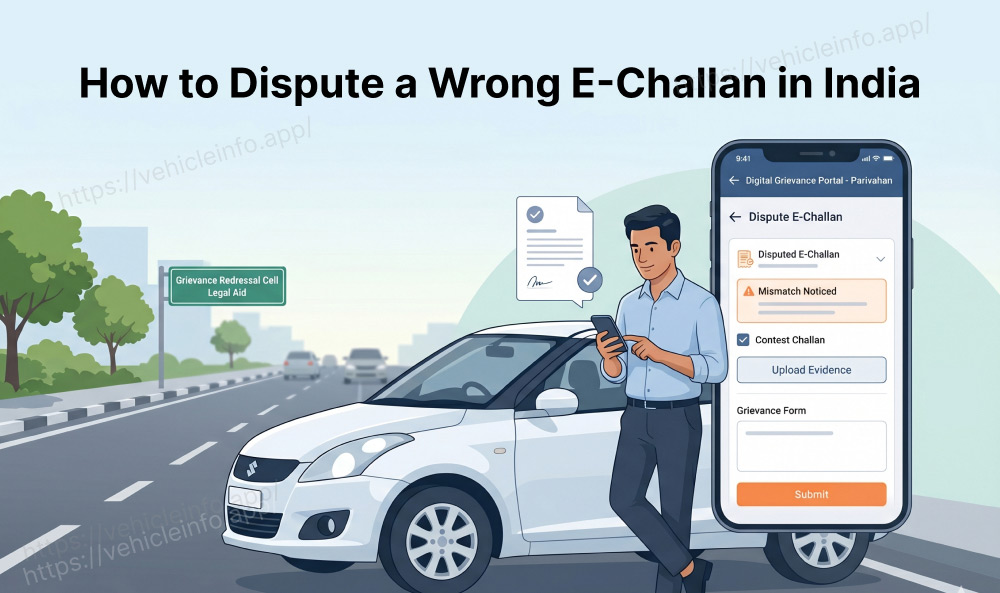
How to Dispute a Wrong E-Challan in India: Your Rights and the Complete Complaint Process
04 June, 2026
Not every traffic challan that lands in your inbox is a legitimate one. India's large-scale ANPR and CCTV enforcement systems have significantly improved road safety, but they are not error-free. Cameras misread characters in number plates, data entry errors creep in during manual challan issuance, and occasionally a challan meant for one vehicle ends up linked to another. If you have received a wrong e-challan, you have clear legal rights and a defined process to dispute e-challan records that should not have been issued to you.
This guide covers every stage of the e-challan dispute process: the common reasons challans are issued incorrectly, your rights under the Motor Vehicles Act, the step-by-step process to dispute e-challan records through official channels, how long it typically takes, and what to do if you run into a dead end.
Why Wrong Challans Happen: The Most Common Reasons
Understanding why wrong challans get issued is important before you begin the process to dispute e-challan records, because the reason for the error often determines which step of the process will resolve it fastest.
The most common causes of a traffic challan mistake are:
Number plate misreads by ANPR cameras: Optical character recognition technology misreads certain character combinations, particularly in poor lighting, at high speed, or when a plate has faded markings or an unusual font. For example, the characters 0 and O, or 1 and I, are frequently confused by ANPR systems. This is the most common cause of an e-challan issued for wrong vehicle scenarios.
Data entry errors by traffic officers: When challans are issued manually using handheld devices, an officer may enter a vehicle number incorrectly. A single transposed digit or letter creates an e-challan error that is linked to an entirely different vehicle.
Multiple vehicles with similar plates: In rare cases, vehicles from different states may have registration numbers that look similar. An out-of-state vehicle caught in a violation can be confused with a local plate.
Technical synchronisation issues: In some cases, vehicle registration data in the RTO database may not be fully updated, leading to incorrect owner details being associated with a challan.
These scenarios make up the bulk of wrong traffic challan India cases reported by vehicle owners. In each of them, you have a clear right to dispute e-challan records and to file a complaint. Understanding how to dispute wrong e-challan records for each cause determines the fastest path to resolution.
Your Rights Under the Motor Vehicles Act When a Challan is Wrong
The Motor Vehicles Act and the associated rules governing e-challans give vehicle owners several important rights when dealing with an incorrect fine.
First, you have the right to receive clear information about the challan. Every e-challan must display the vehicle number, date, time, location, nature of the violation, and the issuing authority. If any of these are missing or incorrect, that itself is a ground to file a complaint wrong challan through the official grievance process.
Second, under the Right to Information Act 2005, you have the right to request the evidence used to generate the challan. This includes CCTV footage, ANPR camera images, or the officer's handheld device records. The request for CCTV evidence challan is one of the most powerful tools in your dispute.
Third, the Motor Vehicles Act provides that you can appear before a traffic court and contest any challan. You are not required to pay first and dispute later. Anyone asking can I challenge e-challan in court should know the answer is yes, and doing so with sufficient evidence means the court can set aside the fine entirely.
Fourth, you have the right to raise a formal challan complaint through the Parivahan portal or the relevant state traffic police website before escalating to court.
How to Dispute a Wrong E-Challan: Five Steps That Work
Step 1: File an Online Complaint on the Parivahan Portal
The first step in the e-challan dispute process is to raise a complaint online. Visit echallan.parivahan.gov.in and look for the grievance or complaint section. Enter your vehicle number and challan details, describe the nature of the error, and submit.
This creates a formal, time-stamped record of your dispute. For many straightforward cases, particularly those involving obvious data entry errors or wrong vehicle number links, this step alone is enough to get the challan reviewed and cancelled. The Parivahan team passes the complaint to the issuing state's traffic police authority for review.
You can also file complaint wrong challan through the relevant state police portal. Most state traffic police websites (such as mahatraffic.nic.in, tnpolice.gov.in, uppolice.gov.in) have grievance sections that allow you to raise a dispute directly with the issuing authority.
Step 2: Request CCTV or ANPR Evidence to Support Your Case
If your challan was generated by a camera, requesting the footage is one of the most effective ways to dispute e-challan records. The CCTV evidence challan request can be made formally in two ways: through the police grievance process, or via an RTI application.
When you request CCTV evidence challan footage from the traffic police, ask for the camera image or video clip. Knowing how to get CCTV footage for challan disputes is straightforward: request in writing from the relevant traffic station and ask for the specific clip timestamped to the alleged violation. If the image clearly shows a different vehicle or a misread plate, this becomes strong evidence.
Keep in mind that CCTV footage is typically retained for 30 to 90 days, depending on the state and infrastructure. Making your request promptly after discovering the challan is essential. Delays beyond 90 days may mean the footage has already been overwritten.
Step 3: File an RTI Application for Challan Proof
If the police grievance process does not produce the evidence or response you need, file a formal Right to Information application. RTI challan proof requests are powerful because they compel the authority to respond within 30 days.
Address the RTI to the Public Information Officer (PIO) of the relevant police department. Request: the CCTV or ANPR image used to generate the challan, the officer's handheld device log if it was manually issued, and a copy of the original challan record. RTI challan proof requests cost Rs 10 and can be filed online through rtionline.gov.in or by post.
If the response confirms an error, use it to support your formal dispute or court case. If no response is provided within 30 days, you can file a first appeal with the Appellate Authority.
Step 4: Approach the Transport Commissioner or Senior Traffic Officer
If the portal grievance and RTI steps have not resolved the e-challan error, escalate to the Transport Commissioner or the Senior Superintendent of Police (Traffic) in your district. A formal written complaint to a senior officer often moves things faster than online submissions, particularly for cases involving clear factual errors.
When approaching this level, carry: a printout of your challan details, the CCTV evidence challan request and response (if any), the RTI challan proof received, and any photographs of your own vehicle.
Step 5: Court Appeal as Last Resort
If administrative channels have failed and the wrong e-challan remains on record, you can raise the question of can I challenge e-challan in court formally. The answer is yes: approach the Motor Accident Claims Tribunal or the appropriate Magistrate's Court in the district where the challan was issued.
The process of how to dispute wrong e-challan in court requires filing a written application, presenting your evidence (RTI proof, CCTV images, vehicle documents), and attending a hearing. If you can challenge e-challan in court with strong documentary evidence, success rates for clearly wrong challans are high. Courts regularly set aside challans where evidence confirms an error. This path takes two to six months, but is the final avenue for a genuinely incorrect fine.
How Long Does the E-Challan Dispute Process Take?
The timeline for each stage varies:
| Stage | Typical Resolution Time |
|---|---|
| Online portal complaint | 2 to 4 weeks |
| CCTV evidence request (police) | 1 to 3 weeks |
| RTI application | 30 days (mandatory response deadline) |
| Transport Commissioner's approach | 2 to 6 weeks |
| Court appeal | 2 to 6 months |
Starting from the portal complaint and working upward gives most drivers a resolution within four to eight weeks for clear-cut cases involving obvious e-challan errors. Complex disputes or those requiring court intervention take longer.
What If the Parivahan Portal Has No Dispute Option?
Some vehicle owners find that their state's portal does not have a clearly visible dispute or grievance section. In this case:
- Go directly to your state's traffic police website and look for a citizen grievance or contact section
- Send a formal written challan complaint by email or registered post to the Superintendent of Police (Traffic) in your district
- Visit the traffic police station in person and request a written acknowledgement of your complaint
Even if no online dispute option exists, your rights under the Motor Vehicles Act and RTI Act remain fully intact. The absence of a digital grievance form does not remove your right to dispute e-challan records that are incorrect.
If your challan is still in its standard payment window on the Parivahan portal (not yet referred to court), Vehicle Info can help you verify the challan details and confirm the issuing authority before deciding whether to pay or dispute e-challan charges.
FAQs
1. How do I dispute a wrong e-challan in India?
Ans: To dispute e-challan records, start by filing a grievance on echallan.parivahan.gov.in or your state traffic police portal. Provide the challan number, vehicle number, and a clear description of the error. If the portal complaint does not resolve it, file an RTI for CCTV evidence and escalate to the Transport Commissioner or traffic court. The full e-challan dispute process typically takes two to eight weeks for clear-cut cases.
2. What is the most common reason for a wrong traffic challan in India?
Ans: The most frequent cause of wrong traffic challan India cases is ANPR camera misreading of number plate characters, particularly lookalike pairs such as 0 and O, or 1 and I. Manual data entry errors by traffic officers are the second most common cause. These e-challan error scenarios are well recognised by traffic police and can often be resolved quickly with evidence.
3. How do I get CCTV footage to dispute e-challan records?
Ans: To understand how to get CCTV footage for challan disputes, file a request through the issuing traffic police's grievance portal or send a written request to the traffic police station. If this does not work, file an RTI to the Public Information Officer of the relevant police department, asking for the camera image or video used to generate the fine. Act promptly: footage may be overwritten after 30 to 90 days, depending on the state's data retention policy.
4. Can I challenge an e-challan in court?
Ans: Yes, you can challenge e-challan in court by approaching the appropriate Magistrate's Court or Motor Accident Claims Tribunal in the district where the challan was issued. Present your vehicle documents, CCTV evidence, and RTI challan proof as supporting material. Courts regularly set aside challans where clear evidence of an error is presented. A court appeal is typically the final step after administrative channels have been exhausted.
5. What should I do if my challan says e-challan issued for wrong vehicle?
Ans: If you have received a challan that clearly belongs to a different vehicle, act immediately to dispute e-challan records. File a complaint on the Parivahan portal or state police portal, attach any evidence of the mismatch (such as a photograph of your actual number plate), and request CCTV evidence challan footage to confirm the error. Most e-challan issued for wrong vehicle cases are resolved at the portal complaint stage once the evidence is clear.
6. How do I file a challan complaint online?
Ans: To file complaint wrong challan online, visit echallan.parivahan.gov.in and go to the grievance or complaint section. You can also use your state traffic police portal. Enter your vehicle number, challan number, and a detailed description of the error. Keep a copy of the complaint reference number for follow-up. Most portals respond within 15 to 30 days with a status update on the investigation.
7. What is RTI challan proof and how does it help?
Ans: RTI challan proof refers to the camera image, ANPR log, or officer's device record obtained through a Right to Information request. Filing an RTI compels the police authority to provide this evidence within 30 days. The RTI challan proof can then be used to support a formal dispute at the traffic police level, with the Transport Commissioner, or in court. It is one of the most powerful tools when administrative complaints have not produced results.
8. What happens to my vehicle if I do not pay a disputed challan while the dispute is ongoing?
Ans: While a challan dispute is in progress, the fine technically remains outstanding on the system. This means your RC renewal or driving licence renewal may be blocked if the system does not recognise a pending dispute. It is advisable to get a formal acknowledgement of your challan complaint (in writing or digitally) and keep it on hand. If RC renewal is urgent, speak with the RTO about the pending dispute to avoid processing delays.
9. How do I know if my wrong e-challan dispute was successful?
Ans: After filing a dispute, log back in to the Parivahan portal or your state police portal after two to four weeks and search for your challan by vehicle number. A successfully resolved dispute will either show the challan as cancelled or removed from the outstanding dues list. You should also receive a written communication from the traffic police or Transport Commissioner confirming the decision if the matter was escalated beyond the portal complaint stage.
10. Is it better to pay first and then dispute, or dispute first and then pay?
Ans: In India, there is no legal requirement to pay a disputed challan before you dispute it. If you believe the challan is a genuine traffic challan mistake, dispute it first. Paying before disputing can be interpreted as an admission of the violation, which weakens your position in court if the matter escalates. The only exception is if the dispute is taking too long and your RC renewal is imminent, in which case paying under protest while filing a parallel written complaint is a pragmatic option.