How to Check and Pay E-Challan in Kerala: A Complete Online Guide
01 June, 2026
Kerala is often cited as one of the strictest states in India when it comes to traffic enforcement, and for good reason. The state has one of the highest vehicle densities per kilometre of road in the country, a road accident rate that has driven a persistent policy focus on enforcement, and a dual enforcement model in which both the Traffic Police and the Motor Vehicles Department (MVD) have the authority to issue traffic fines. The e-challan Kerala system captures violations from all these sources digitally, links them to your vehicle number, and makes them available to check and pay online.
Whether you received a message about a pending fine after driving along NH-66, through Kochi's city roads, or on the mountain routes to Munnar or Wayanad, or you simply want to do a Kerala traffic fine check before renewing your RC, this guide has everything you need. We cover how the system works, how to check your challan status, how to pay it, what the common fines are, and how to dispute one that was issued incorrectly.
How the E-Challan System Works in Kerala
The e-challan Kerala system runs on the national digital enforcement framework established by the Ministry of Road Transport and Highways. Still, the state brings a significant and distinctive addition to the standard model. In most states, only the traffic police issue challans. In Kerala, the Motor Vehicles Department also conducts active enforcement through dedicated MVD Flying Squads, which carry out surprise checks on vehicle fitness, overloading, documentation violations, and road-worthiness. Both the traffic police and the MVD can generate a Kerala traffic police challan through the e-challan system.
Violations are captured through CCTV cameras at signalised junctions, ANPR cameras on key highways including NH-66 (the coastal highway from Kasaragod to Thiruvananthapuram), and handheld devices used by both traffic officers and MVD squad members during routine and surprise enforcement drives.
When a violation is recorded, each e-challan Kerala generated is linked to the vehicle's registration number on the Parivahan database. The vehicle owner receives an SMS notification on the mobile number registered with the Kerala RTO, and the Kerala RTO challan appears online within 24 to 72 hours.
Active enforcement zones across the state include the NH-66 coastal corridor, the Kochi urban area and Ring Road, the Thiruvananthapuram city limits, Kozhikode and Thrissur city roads, and all mountain highway routes, including those leading to Munnar, Wayanad, and Thekkady, where speeding on winding roads is a persistent enforcement priority.
How to Check Your E-Challan Status in Kerala: Three Methods That Work
There are three dependable ways to check your e-challan Kerala status. Here is how each one works.
Via the Kerala Traffic Police State Portal
The Kerala Police website at keralapolice.gov.in provides access to e-challan records and is the primary state-level portal for traffic enforcement information.
Steps:
- Visit keralapolice.gov.in and navigate to the e-challan or traffic fine section
- Enter your vehicle registration number (for example, KL07AB1234) or your driving licence number
- Submit and view all outstanding challans linked to your vehicle
This is the best route to check challan Kerala records issued by traffic officers or MVD squads using handheld devices, which may take a day or two to sync with the national Parivahan database. The state portal is also useful for tracking the Kerala e-challan status of MVD-issued fines, which sometimes appear here before they reflect on Parivahan.
Via the Parivahan National Portal
The national e-challan portal at echallan.parivahan.gov.in is the most comprehensive database for how to check challan in Kerala, aggregating records from all enforcement channels across the state.
Steps:
- Visit echallan.parivahan.gov.in
- Click on Check Challan Status
- Enter your vehicle number, challan number, or driving licence number
- Complete the captcha and click Get Detail
ANPR-generated challans from NH-66 and other highway corridors tend to appear on Parivahan fastest. Checking your Kerala e-challan status here is recommended as a first step for any highway fine and for challans issued in districts away from your home area.
Via Mobile Apps
For a quick Kerala traffic fine check from your phone, two apps stand out:
- mParivahan: The official NIC government app. Enter your vehicle number to view all linked challans and basic vehicle details instantly.
- Vehicle Info: A third-party platform that pulls data from the Parivahan database and presents your Kerala e-challan status in a clean, readable format. You can check challan Kerala records using just your registration number and move straight to payment without switching between portals.
The Vehicle Info Kerala challan page covers challans from both Kerala Traffic Police and MVD sources in a single view, which is particularly useful given the state's dual enforcement model. If you are looking for how to check challan in Kerala quickly without navigating multiple portals, this is the most direct option available.
Pay Your Kerala Traffic Challan Online: All the Options
Once you have located your outstanding challan, you can pay challan Kerala online through several channels. Here is the complete breakdown.
Via the Parivahan Portal:
1. Visit echallan.parivahan.gov.in and search for your challan by vehicle or challan number
2. Click Pay Now on the pending e-challan Kerala fine
3. Select your payment method: UPI, debit card, credit card, or net banking
4. Complete the payment and download your receipt
Via the Kerala Police Portal:
After locating your challan on keralapolice.gov.in, click Pay and proceed through the payment gateway. Kerala challan payment online through the state portal accepts all standard digital payment modes, including UPI and card payments.
Via Vehicle Info:
Vehicle Info offers a particularly smooth Kerala challan payment online experience. Enter your vehicle registration number, view all pending fines from both traffic police and MVD sources, and pay directly using any of the Kerala e-challan payment methods supported on the platform: UPI, debit card, credit card, or net banking. The entire process takes under two minutes and the payment reflects on official records within 24 to 48 hours.
Via UPI Apps:
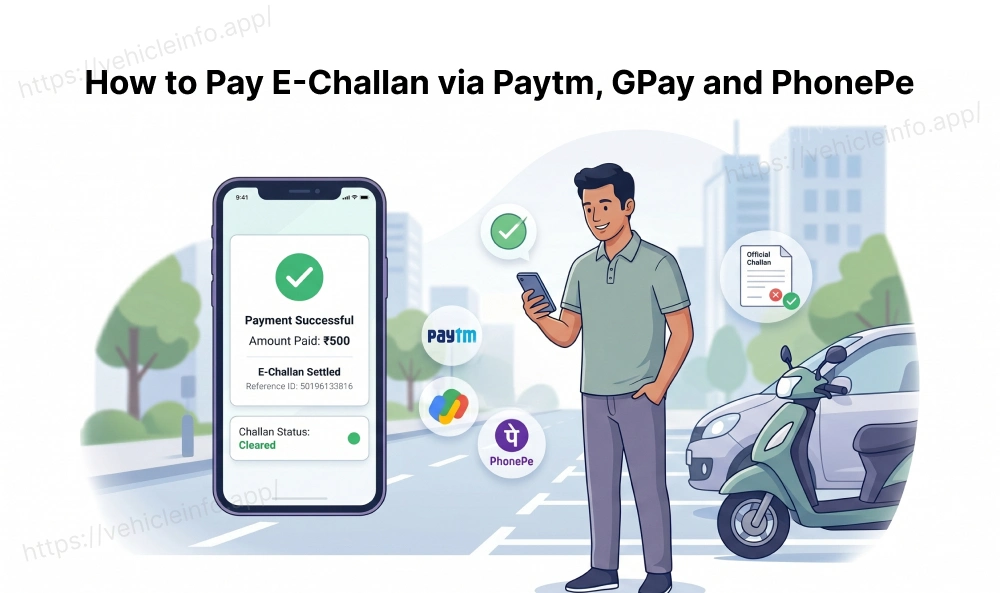
Paytm, Google Pay, and PhonePe all support direct challan payments. Open the app, find the e-challan or traffic fine section, enter your vehicle or challan number, and confirm. These are among the most widely used Kerala e-challan payment methods, requiring no additional registration and generating an instant digital receipt.
After paying through any of the above channels, always save your receipt. Payments typically reflect on the Parivahan portal within 24 to 48 hours. If the status has not updated after 48 hours, the receipt serves as proof of payment until the system syncs.
Traffic Violations and Fines in Kerala: What You Can Expect to Pay
The table below covers the most common reasons a traffic challan Kerala is issued, with fine amounts applicable under the Motor Vehicles (Amendment) Act, 2019.
| Violation | Fine Amount |
|---|---|
| Riding without a helmet | Rs 1,000 |
| Not wearing a seatbelt (front seat) | Rs 1,000 |
| Not wearing a seatbelt (rear seat) | Rs 1,000 |
| Using a mobile phone while driving | Rs 1,000 (first); Rs 2,000 (repeat) |
| Jumping a red light | Rs 1,000 to Rs 5,000 |
| Overspeeding (light vehicle, city) | Rs 1,000 to Rs 2,000 |
| Overspeeding (mountain roads and NH-66) | Rs 2,000 to Rs 4,000 |
| Drunk driving (first offence) | Rs 10,000 plus up to 6 months imprisonment |
| Drunk driving (repeat offence) | Rs 15,000 plus up to 2 years imprisonment |
| Driving without a valid licence | Rs 5,000 |
| Driving without valid insurance | Rs 2,000 |
| Vehicle fitness violation (MVD-issued) | Rs 2,000 to Rs 5,000 |
| Overloading (commercial vehicle, MVD) | Rs 2,000 per tonne over limit |
| Wrong parking | Rs 500 to Rs 1,000 |
Kerala applies the national fine structure from the 2019 MV Act amendment. The e-challan Kerala volume from MVD-issued fines is notably higher than in most other states, because the MVD Flying Squads focus specifically on documentation and fitness violations that traffic officers typically do not enforce. This makes Kerala unique in that a significant portion of Kerala RTO challan records come from MVD inspections rather than road-side traffic violations.
On mountain roads and the NH-66 corridor, overspeeding enforcement is among the most consistently applied categories, given Kerala's high road accident rate on these stretches.
Kerala Traffic Police and MVD Contacts
For queries related to your challan or to report a traffic enforcement issue, here are the key contacts:
| Contact | Details |
|---|---|
| Kerala Police Emergency | 112 |
| Police Control Room | 100 |
| Road Accident Helpline | 1073 |
| Kerala Police Website | keralapolice.gov.in |
| MVD Kerala Website | mvd.kerala.gov.in |
For city-level Kerala traffic police challan queries:
- Kochi Traffic Police: Contact through the Kochi City Police or visit the nearest traffic police division office
- Thiruvananthapuram Traffic Police: The Thiruvananthapuram City Police manages all traffic enforcement records for the capital area
- Kozhikode Traffic Police: Contact through the Kozhikode City Police for all local challan and traffic queries
- Thrissur Traffic Police: Reachable through the Thrissur City Police portal or traffic division office
For the Kerala traffic police helpline in your district, visit keralapolice.gov.in and select your district for local control room contact details. For MVD-issued challan queries specifically, visit mvd.kerala.gov.in to reach the relevant regional transport office.
Dispute a Wrong E-Challan in Kerala: Steps and Rights
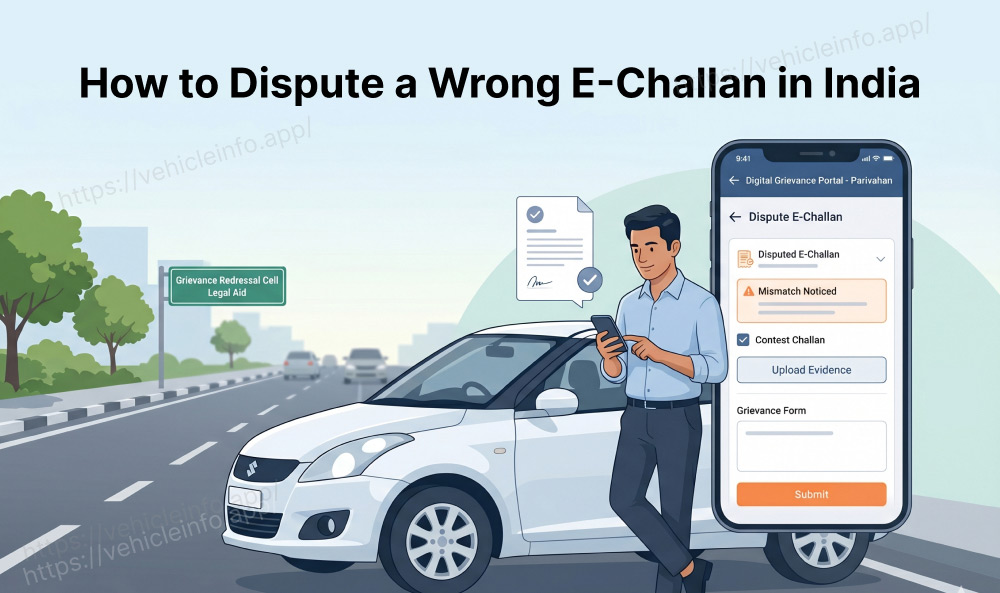
If an e-challan Kerala has been raised against your vehicle in error, whether by the traffic police or the MVD, here is the process to address it.
Step 1: Verify the challan details. Log in to echallan.parivahan.gov.in or the Kerala Police portal and check the vehicle number, violation type, location, and timestamp. For MVD-issued challans, also check whether the violation category matches your vehicle type and registration details, as clerical mismatches are a common source of errors.
Step 2: Visit the relevant traffic court or RTO. Disputing a traffic challan Kerala typically requires a visit to the traffic court in the district where the violation was recorded. For MVD-issued challans, you may need to approach the Regional Transport Office (RTO) rather than the traffic court, depending on the nature of the violation. Bring your RC, driving licence, insurance certificate, fitness certificate, and any supporting evidence.
Step 3: Request camera or inspection footage. Under the Right to Information Act, you are entitled to request the CCTV or ANPR footage used to generate your Kerala RTO challan. For MVD squad-issued challans, you can request the inspection report and officer details. File an RTI with the relevant Police Superintendent (Traffic) or the Regional Transport Officer.
Step 4: File an online grievance. The Kerala Police and MVD websites both have grievance sections. Filing an online complaint creates a formal record of your dispute and is a recommended parallel step to any court or RTO visit.
Why Vehicle Info Is the Smartest Way to Handle Your Kerala Challan
Challans from the traffic police and challans from MVD squads sometimes appear on different portals at different times, making it genuinely difficult to know whether your vehicle has outstanding dues. Vehicle Info resolves this by aggregating data from both the national Parivahan system and state-level sources, displaying your complete e-challan Kerala record in one place.
You enter your vehicle registration number on Vehicle Info, all outstanding fines appear together regardless of whether they were issued by the traffic police or the MVD, and you pay directly on the platform using any of the Kerala e-challan payment methods it supports.
The platform also displays your RC details, insurance validity, PUC status, and fitness certificate, which is particularly valuable in Kerala where MVD squads actively check these documents.
FAQs
1. How do I check my e-challan in Kerala?
Ans: To check your e-challan Kerala status, visit echallan.parivahan.gov.in or the Kerala Police website at keralapolice.gov.in and enter your vehicle registration number or driving licence number. The Vehicle Info platform and the mParivahan app are faster alternatives that show all pending challans without requiring a login. Kerala also has MVD-issued challans, which may appear on mvd.kerala.gov.in before syncing to Parivahan.
2. How do I pay my traffic challan in Kerala online?
Ans: To pay challan Kerala online, visit echallan.parivahan.gov.in, locate your pending fine, and click Pay Now. You can also use the Vehicle Info platform for direct Kerala challan payment online through UPI, debit card, credit card, or net banking. UPI apps including Paytm, Google Pay, and PhonePe are also accepted. Save your payment receipt as the status may take up to 48 hours to update on the portal.
3. What is the Kerala traffic police helpline number?
Ans: The Kerala traffic police helpline for general emergencies is 112. For road accident assistance, call 1073. For district-specific challan queries, visit keralapolice.gov.in and select your district for the local traffic control room contact. For MVD-related challan queries, visit mvd.kerala.gov.in to find the contact for your Regional Transport Office.
4. What is the MVD and why does it also issue challans in Kerala?
Ans: The Motor Vehicles Department (MVD) in Kerala has enforcement authority under the Motor Vehicles Act alongside the traffic police. MVD Flying Squads conduct surprise inspections for vehicle fitness, overloading, documentation violations, and expired certificates. Both bodies can generate a Kerala traffic police challan through the same e-challan system, which is why some Kerala vehicle owners receive challans from MVD sources rather than on-road traffic officers.
5. How long does it take for a Kerala e-challan to appear online?
Ans: A Kerala e-challan typically appears on the Parivahan portal or state portal within 24 to 72 hours of the violation being recorded. ANPR-generated challans from NH-66 and highway corridors tend to sync fastest. MVD-issued challans may take slightly longer. If your challan is not visible after 72 hours, check both echallan.parivahan.gov.in and keralapolice.gov.in, as update timings can differ.
6. What Kerala e-challan payment methods are available?
Ans: Kerala e-challan payment methods include UPI through Paytm, Google Pay, and PhonePe, as well as debit cards, credit cards, and net banking. All are accepted on the Parivahan portal, the Kerala Police portal, and the Vehicle Info platform. Each transaction generates a digital receipt, which should be saved until the challan status confirms as cleared on the relevant portal.
7. Can I dispute a wrong e-challan in Kerala?
Ans: Yes. To dispute a wrong e-challan Kerala, verify the challan details on the Parivahan portal, then visit the traffic court or RTO in the relevant district with your vehicle documents and evidence. You can request camera or inspection footage under the RTI Act and file a formal online grievance on the Kerala Police or MVD website. MVD-issued challans should be disputed through the RTO rather than the traffic court.
8. What happens if I do not pay my Kerala traffic challan?
Ans: Ignoring a traffic challan Kerala has escalating consequences. Your vehicle's RC renewal and driving licence renewal can both be blocked. Any transfer of the vehicle during a sale will also be affected. In Kerala, MVD squads actively check for outstanding challans during vehicle inspections, which means an unpaid fine can also surface during a fitness certificate renewal or vehicle transfer check.