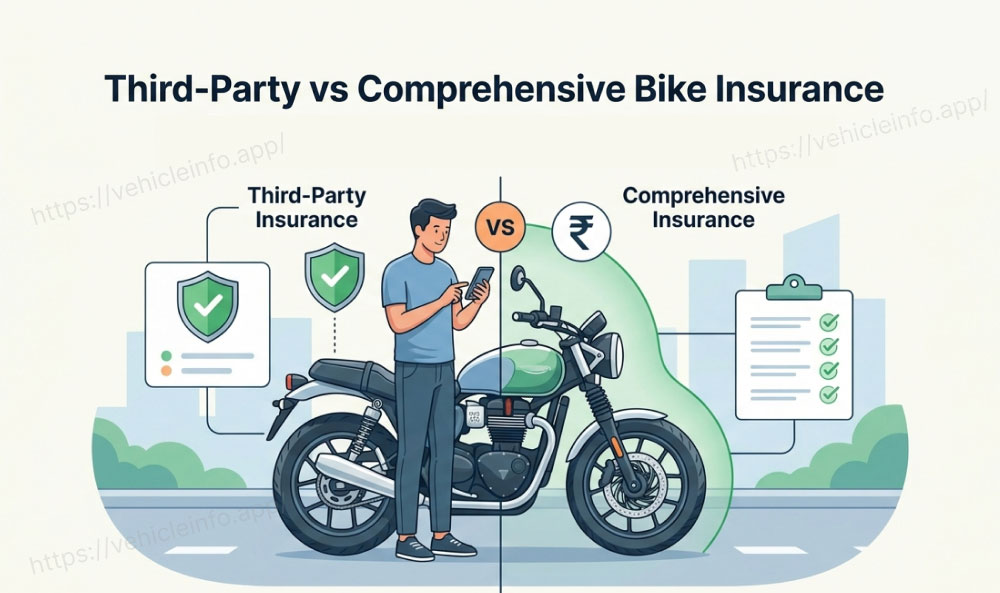
Third-Party vs Comprehensive Bike Insurance: Differences, Cost and Which to Choose
19 June, 2026
The single most common question when buying a two-wheeler policy in India is whether to pay the additional cost for comprehensive cover or stick with the mandatory third-party minimum. The third party vs comprehensive bike insurance decision is not always obvious, and the wrong choice in either direction costs money. The third party vs comprehensive bike insurance question comes down to three variables: your bike's value, your financial capacity to absorb a large repair or theft loss out of pocket, and how you assess the probability of needing to claim.
This guide gives you a clear answer on the third party vs comprehensive bike insurance question upfront, then explains exactly what each covers, how the cost difference plays out, and a decision framework for your situation.
Quick Answer: Which Should You Buy?
For bikes less than five years old or worth more than Rs 40,000 to Rs 50,000: buy comprehensive cover.
For bikes more than seven years old with a low IDV (under Rs 25,000): third-party alone may be financially rational.
The rest of this guide explains the reasoning in full. The third party vs comprehensive bike insurance comparison involves both coverage and cost, and the right answer is different for different riders.
What Third-Party Bike Insurance Covers
A third-party policy is the legally mandatory minimum for all two-wheelers in India. It covers only liability you incur toward other people: if your bike injures someone or damages their property, the policy pays the compensation. It does not cover your own bike under any circumstances.
Under a standard third-party policy:
- Third-party bodily injury: covered (unlimited liability for death and personal injury)
- Third-party property damage: covered (up to Rs 7.5 lakh)
- Mandatory Personal Accident cover for owner-driver: Rs 15 lakh (included)
- Own bike damage from an accident: not covered
- Own bike theft: not covered
- Fire or natural disaster damage to your bike: not covered
The mandatory personal accident cover of Rs 15 lakh is included in both TP and comprehensive policies from 2019 onwards, so this benefit does not differentiate the two types.
The bike third party enough argument is most valid when the bike's resale value is so low that paying the repair cost out of pocket is more economical than the additional comprehensive premium. For a ten-year-old scooter worth Rs 15,000, a comprehensive policy with IDV of Rs 15,000 may carry an OD premium of Rs 300 to Rs 600 per year. In this case, bike third party enough is a defensible position. Whether TP vs comprehensive two wheeler cover represents better value at this IDV level is genuinely close, and bike third party enough arguments become stronger as IDV falls.
What Comprehensive Bike Insurance Covers
A comprehensive policy includes everything in a third-party policy and adds Own Damage (OD) cover for your own vehicle. Comprehensive cover protects your bike against:
- Accidental damage (collision, overturning, impact)
- Theft (complete vehicle, subject to FIR requirements)
- Fire, explosion, and self-ignition
- Natural disasters: flood, cyclone, earthquake, landslide, hailstorm
- Riots, strikes, and malicious damage
- Third-party liability (same as TP policy)
- Personal accident cover for owner-driver (same as TP policy)
In addition, a comprehensive policy is the only type to which add-ons can be attached: zero depreciation, engine protection, roadside assistance, NCB protection, and other supplementary covers are only available with comprehensive policies.
The bike comprehensive worth it question resolves clearly in favour of comprehensive cover when any of the following are true: the bike is worth more than a few months of OD premium, you ride in areas with high theft risk, or you ride in cities with monsoon flooding or high accident frequency.
Two Wheeler Insurance Comparison: Eight Key Parameters
| Parameter | Third-Party Only | Comprehensive |
|---|---|---|
| Third-party liability | Yes | Yes |
| Own accident damage | No | Yes |
| Theft | No | Yes |
| Fire and explosion | No | Yes |
| Natural disaster damage | No | Yes |
| Add-on covers | Not available | Available |
| Annual premium | Lower | Higher |
| Recommended for | Very old, low-value bikes | New and mid-age bikes |
This two-wheeler insurance comparison makes the coverage difference concrete. The eight parameters above cover every meaningful scenario a rider is likely to face. The only dimension where TP has an advantage is premium cost, and that advantage diminishes as the bike's value increases.
Cost Difference: How Much More Does Comprehensive Cost?
The comprehensive vs TP cost difference bike owners actually pay depends on the bike's IDV. The TP component is fixed by IRDAI at Rs 714 per year for bikes up to 150cc. The OD component is typically 1.5 to 2.5 per cent of IDV per year.
| Bike Profile | IDV | OD Premium | TP Premium | Total Comprehensive | TP Only |
|---|---|---|---|---|---|
| New 150cc commuter | Rs 80,000 | Rs 1,600 | Rs 714 | ~Rs 2,730 (inc. GST) | ~Rs 843 |
| 3-year-old 150cc | Rs 56,000 | Rs 1,120 | Rs 714 | ~Rs 2,160 | ~Rs 843 |
| 5-year-old 150cc | Rs 40,000 | Rs 800 | Rs 714 | ~Rs 1,795 | ~Rs 843 |
| 7-year-old 150cc | Rs 25,000 | Rs 500 | Rs 714 | ~Rs 1,453 | ~Rs 843 |
The comprehensive vs TP cost difference bike owners pay for a new bike is approximately Rs 1,887 per year. For a seven-year-old bike, the difference narrows to approximately Rs 610 per year.
For the new bike, that Rs 1,887 annual premium difference buys cover that can pay out Rs 80,000 in a total loss or several thousand in a partial damage claim. The cost-benefit case for comprehensive cover is extremely strong when the IDV is high.
For the seven-year-old bike, the Rs 610 annual difference buys cover with a maximum payout of Rs 25,000. Whether that is worth it depends on the owner's financial position and local theft/accident risk.
Decision Framework: When TP Is Enough, When It Is Not
Should I buy comprehensive bike insurance or is third-party sufficient? Here is a practical decision guide:
Buy comprehensive if:
- Your bike is less than five years old
- Your bike has an IDV above Rs 40,000
- You live in a city with high theft rates, monsoon flooding, or dense traffic
- You ride on highways where accident risk is higher
- You cannot absorb a Rs 30,000 to Rs 80,000+ repair or replacement cost without financial strain
Stick with third-party if:
- Your bike is more than eight years old
- Your IDV is under Rs 20,000 to Rs 25,000
- The annual OD premium represents a high proportion of the IDV (for example, paying Rs 500 per year to insure a Rs 15,000 bike)
- You have a second vehicle and use this bike only occasionally
- Is TP enough for old bike? Yes, if the IDV has fallen below the threshold where own damage cover makes financial sense
Is TP enough for old bike in a city with high accident frequency? The third party vs comprehensive bike insurance choice for old bikes remains worth evaluating even when the IDV is low. Even for a low-IDV old bike, third-party cover at minimum is non-negotiable. Comprehensive cover remains worth evaluating even for old bikes if theft risk is high in your locality.
The bike TP vs comprehensive decision is ultimately a risk management calculation. Anyone still unsure about the third party vs comprehensive bike insurance choice after reading this guide should use the cost difference table above and calculate what proportion of their IDV they would pay in annual OD premium. If you cannot afford to absorb a total loss out of pocket, comprehensive cover is the right choice regardless of bike age.
Check your current bike insurance status and validity at Vehicle Info. Enter your registration number to see your active policy details, IDV, and expiry date alongside your RC and PUC status. If your policy is up for renewal and you are revisiting the third-party vs comprehensive bike insurance decision, this is the right moment to reassess based on your bike's current age and IDV rather than defaulting to whatever you had before.
Frequently Asked Questions
1. Should I buy comprehensive bike insurance or just third-party?
Ans: Should I buy comprehensive bike insurance depends on your bike's value and your financial position. For bikes less than five years old or worth more than Rs 40,000 to Rs 50,000, comprehensive cover is almost always the right choice. The annual premium difference for a new 150cc bike is approximately Rs 1,500 to Rs 2,000, which buys coverage for theft, accidents, and natural disasters.
2. Is third-party enough for an old bike?
Ans: It depends on the IDV. For bikes more than seven or eight years old with an IDV under Rs 20,000 to Rs 25,000, the cost of comprehensive cover may not be justified by the maximum potential payout. Paying Rs 500 to Rs 600 per year in OD premium to insure a bike worth Rs 15,000 requires careful calculation. Third-party alone is legally sufficient; whether it is financially sufficient depends on your risk tolerance.
3. How much more does comprehensive bike insurance cost than third-party?
Ans: The comprehensive vs TP cost difference bike owners pay is driven by the OD premium, which is 1.5 to 2.5 per cent of IDV. For a new 150cc bike with IDV of Rs 80,000, the annual difference is approximately Rs 1,500 to Rs 2,000. For a five-year-old bike with IDV of Rs 40,000, the difference narrows to approximately Rs 600 to Rs 900. The two-wheeler insurance comparison always favours comprehensive when the IDV is Rs 40,000 or above.
4. What does TP vs comprehensive two-wheeler insurance mean?
Ans: Third party vs comprehensive bike insurance: TP vs comprehensive two wheeler refers to the two main policy types. Third-party (TP) covers only liability to other road users. Comprehensive covers TP liability plus your own bike's damage from accidents, theft, fire, and natural disasters. The bike TP vs comprehensive distinction is the most fundamental choice in any two-wheeler insurance purchase. Choosing the wrong option costs you either an unnecessary premium (if you over-buy) or a significant out-of-pocket loss (if you under-buy and need to claim).
5. Can I upgrade from third-party to comprehensive insurance?
Ans: You cannot typically convert a TP-only policy mid-term to a comprehensive one without cancelling and reissuing. The upgrade must happen at renewal. At renewal, simply select comprehensive cover with the desired IDV and add-ons. If your current TP policy is near expiry, this is the right time to reassess and switch. Bike comprehensive worth it evaluations are most straightforward at renewal time when you can compare quotes across insurers on the same terms.
6. What is not covered even with comprehensive bike insurance?
Ans: Even with the most comprehensive cover, standard exclusions apply: normal wear and tear, mechanical or electrical breakdown unrelated to an accident, damage while riding without a valid licence or under the influence of alcohol, and consequential damage. Tyres and tubes are also excluded unless the bike itself is damaged in the same incident. Understanding these exclusions is as important as knowing what a policy covers.