What Happens If You Don't Pay E-Challan? Consequences, Legal Action and How to Clear Old Fines
18 June, 2026
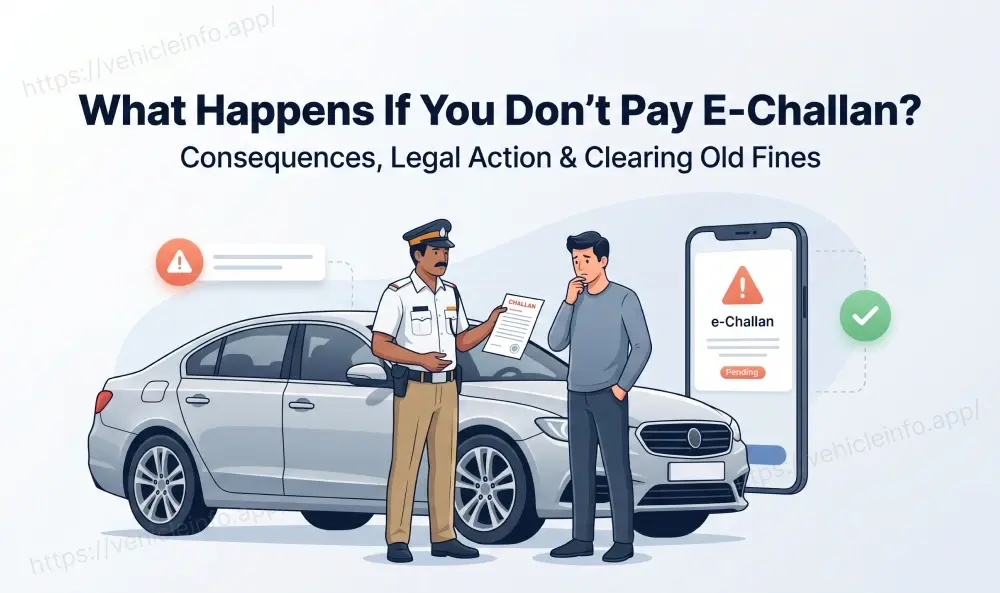
Ignoring a traffic challan is a common choice, particularly when the fine amount seems modest. But understanding what happens if you don't pay e-challan changes the calculation entirely. For many vehicle owners, what happens if you don't pay e-challan only becomes clear when an RC renewal is blocked, a court summons arrives, or a challan warrant is issued. The consequences are not immediate, but they are cumulative and escalate through several stages: from a blocked vehicle renewal to a court summons and eventually a challan warrant that can result in a police visit. Knowing what happens if you don't pay e-challan at each stage lets you act before it becomes serious. This guide maps the full consequence timeline, explains exactly when each stage kicks in, and shows you how to clear old fines before they reach the most serious stage.
Immediate Consequences: The Fine Stays but a Clock Starts
The most important thing to understand about unpaid challan consequences is that the fine amount does not increase with interest under the standard e-challan framework. When a challan is first issued, and you ask what happens if you don't pay e-challan immediately, the practical answer is: the fine stays the same, but a referral clock begins running.
Most state traffic authorities refer unpaid challans to traffic courts after a period of six to twelve months of non-payment. Before that referral, the challan simply sits in the Parivahan database as outstanding. You receive reminders via SMS and, in some states, letters to your registered address. The amount due remains the same as on the day of issuance.
What happens if you don't pay e-challan during this first window is therefore manageable: pay before court referral and the fine stays at the original amount. The immediate stage is therefore the most forgiving. But that window is not unlimited, and many vehicle owners misread the absence of immediate consequences as permission to ignore the challan indefinitely.
Medium-Term Consequences: Renewals and Transfers Blocked
Once an e-challan is in the Parivahan database as outstanding, it affects your ability to complete several routine vehicle administration tasks.
- RC renewal blocked challan: When your vehicle's Registration Certificate is due for renewal, the RTO system performs an outstanding challan check. If any e-challan not paid records are found, the renewal is blocked until all dues are cleared. This applies to both standard RC renewals and to fitness certificate renewals for commercial vehicles.
- DL renewal blocked challan: In states where the traffic police database is integrated with the licensing authority, outstanding challans block driving licence renewal. The DL renewal blocked challan process is most consistently enforced in Delhi, Mumbai, Hyderabad, and cities with fully integrated digital systems. The DL renewal blocked challan mechanism means the licensing officer cannot process the renewal until all fines are cleared. This is most consistently enforced in Delhi, Mumbai, and cities with tightly integrated digital systems.
- Vehicle transfer blocked: Selling or transferring ownership of a vehicle requires a clear challan record. If you attempt to transfer your vehicle's ownership with outstanding fines, the RTO process will be flagged and the transfer cannot proceed until the unpaid traffic fine consequences are resolved.
How long can I ignore e-challan before these blocks become active? What happens if you don't pay e-challan becomes financially concrete at the point of your next renewal or transfer attempt, not at a fixed time after the challan is issued. A vehicle owner who does not renew the RC for several years may never encounter the block until they finally try, at which point all accumulated fines must be cleared.
Long-Term Consequences: Court Summons and Challan Warrants
The most serious unpaid challan consequences arise when the matter is referred to a traffic magistrate's court. This typically happens after six to twelve months of non-payment, though the timeline varies by state.
Once an e-challan court summons is issued, the case moves from a simple fine to a criminal proceeding under the Motor Vehicles Act. The court summons is sent to your registered address. If the summons is ignored, the court has the authority to issue a challan warrant directing the police to produce you before the magistrate.
At the court stage, the magistrate has discretion to:
- Impose the original fine amount
- Impose a higher fine than the original challan amount
- Order community service as an alternative
- In cases of serious non-compliance, impose a short-term custodial sentence
Will I get arrested for unpaid challan? Technically yes, if a warrant has been issued and you repeatedly fail to respond. In practice, courts rarely impose custodial sentences for standard traffic violations. But the police visit that accompanies warrant execution is disruptive and avoidable.
Can You Get Arrested for an Unpaid E-Challan?
Will I get arrested for unpaid challan is one of the most frequently asked questions about this topic, and the answer requires nuance.
A challan warrant is a civil warrant, not a criminal arrest warrant. Its purpose is to compel your appearance before the traffic magistrate, not to imprison you. When police execute a challan warrant, the typical outcome is that you are brought to the magistrate's court, the case is heard, and you pay the fine with any additional court costs. Imprisonment for a standard traffic challan without associated criminal conduct is extremely rare.
However, the disruption of a challan warrant execution, the potentially higher fine at the court stage, and the time cost of court appearances make the escalation to this stage genuinely harmful even without imprisonment. The better question is not will I get arrested for unpaid challan but why allow it to reach this stage at all.
How to Clear Old Pending Challans Now
Clearing unpaid challans before they reach the court stage is straightforward. Here is the process:
- Check all outstanding challans. Visit echallan.parivahan.gov.in and enter your vehicle registration number. All pending e-challan not paid records appear, including older ones. You can also check challan through Vehicle Info, which aggregates data from the national Parivahan database and state portals.
- Identify which challans are still in the standard payment window (not yet court-referred). These can be paid directly online through Parivahan, Vehicle Info, or UPI apps.
- For court-referred challans, check vcourts.gov.in or your state's virtual court portal. Court-referred challans cannot be paid through the standard Parivahan flow: they must be paid through the court system.
- Pay and save your receipt. After payment, the challan status updates in the database within 24 to 48 hours.
Can I renew RC if challan pending? No. Clear all outstanding challan not paid what happens to vehicle compliance is straightforward: everything requiring an RTO transaction is blocked. Clear all pending fines before attempting any renewal. The system will block the renewal until all fines are settled.
The Lok Adalat Option for Multiple Old Challans
If you have accumulated several old challans that have been referred to court, Lok Adalat is the most efficient route for bulk settlement. Lok Adalat sessions are held four times a year nationally, and traffic challans are among the most common cases handled.
At a Lok Adalat session, the presiding officer can offer to settle your challan at a significantly reduced amount. Reductions of 50 to 75 per cent on old challans are standard, and reductions of up to 90 per cent on very old challans are not uncommon. Once settled at Lok Adalat, the matter is permanently closed and cannot be reopened.
Check the next National Lok Adalat date at nalsa.gov.in and confirm whether your specific challans are eligible for inclusion. Challans must be in the court system to qualify for Lok Adalat settlement.
Frequently Asked Questions
1. What happens if you don't pay an e-challan in India?
Ans: The consequences escalate in stages. What happens if you don't pay e-challan follows a predictable timeline that every vehicle owner should understand. Immediately, the fine stays at the same amount but your RC and DL renewals are blocked. After six to twelve months, the challan is referred to traffic court and an e-challan court summons is issued. If the summons is ignored, a challan warrant may be issued. Unpaid traffic fine consequences are serious and grow more disruptive the longer payment is delayed.
2. Will my RC renewal be blocked if I have an unpaid challan?
Ans: Yes. RC renewal blocked challan enforcement is active across all states using the Parivahan system. When you apply for RC renewal, the RTO database checks for outstanding challans. If any e-challan not paid records are linked to your vehicle number, the renewal process cannot be completed until all dues are cleared. The same applies to fitness certificate renewals for commercial vehicles.
3. Can I renew my RC if a challan is pending?
Ans: All outstanding traffic fines linked to the vehicle must be paid before the renewal application is processed. Pay all pending challans first through echallan.parivahan.gov.in or Vehicle Info, then re-apply for renewal. The challan clearance typically reflects in the RTO system within 24 to 48 hours of payment.
4. Will I get arrested for not paying an e-challan?
Ans: While possible but extremely rare for standard traffic violations. The more likely sequence is: challan warrant issued by the magistrate, police visit to compel your appearance in court, court hearing, fine payment with additional court costs. Actual imprisonment for a standard challan without criminal conduct is unusual. The practical risk is the disruption and higher cost of the court stage, not imprisonment.
5. How long can I ignore an e-challan before serious consequences?
Ans: Action depends on the state, but most traffic authorities refer unpaid challans to court after six to twelve months. Before that, the main consequence is the blocked RC and DL renewal. After court referral, an e-challan court summons arrives, and the consequences escalate. The safest approach is to pay within the standard 30-day window shown on the challan.
6. What is the difference between paying through Parivahan and the virtual court?
Ans: Challans still in the standard window must be paid through echallan.parivahan.gov.in or Vehicle Info. Challans that have been referred to court must be paid through vcourts.gov.in or your state's virtual court system. Attempting to pay a court-referred challan through Parivahan will show no pending amount because the record has moved out of the standard payment flow into the court system.
7. Can old unpaid challans from years ago still be cleared?
Ans: Yes. Old e-challan not paid records remain in the Parivahan and court systems indefinitely. Understanding challan not paid what happens after several years means recognising that both the payment and the court referral consequences remain active until resolved. If the challan is still in the standard Parivahan flow, it can be paid directly online. If it has been court-referred, it must be paid through the court system or settled at a Lok Adalat session. The challan warrant risk means clearing old challans sooner is strongly preferable to waiting further.
8. What is a Lok Adalat and can it help with old traffic challans?
Ans: Lok Adalat is an alternative dispute resolution forum under the Legal Services Authorities Act, 1987. For traffic challans that have been referred to court, Lok Adalat sessions offer the opportunity to settle at 50 to 90 per cent of the original amount. Once settled, the unpaid challan consequences end permanently: the case is closed and cannot be reopened. Sessions are held four times a year nationally. Visit nalsa.gov.in for upcoming dates.