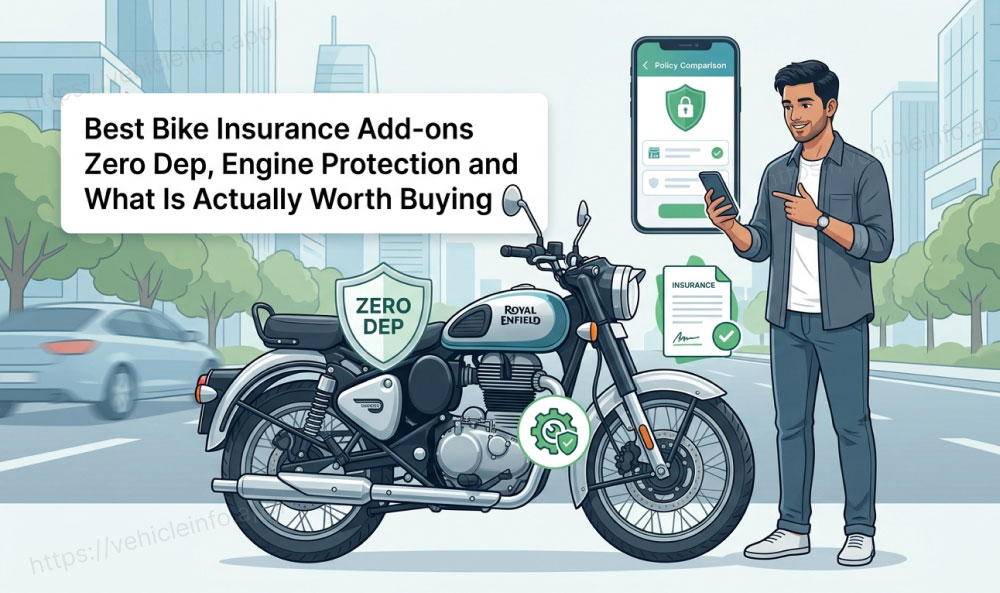
Best Bike Insurance Add-ons: Zero Dep, Engine Protection and What Is Actually Worth Buying
19 June, 2026
A base comprehensive policy for your two-wheeler covers the essentials: accidents, theft, fire, and natural disasters. But the standard cover leaves several gaps that can make a significant difference when you actually need to file a claim. Bike insurance add-ons are optional covers that plug these gaps, and the right selection can mean the difference between a fully settled claim and an out-of-pocket payment that surprises you.
The challenge is that not every add-on is worth buying for every bike. A zero-dep policy on a seven-year-old scooter with a low IDV makes limited financial sense. An engine protection add-on on a new bike in a flood-prone city, on the other hand, can save you tens of thousands of rupees. This guide helps you decide which bike insurance add-ons are genuinely useful for your situation.
What Are Bike Insurance Add-ons and How Do They Work?
Bike insurance add-ons are supplementary covers that are attached to a comprehensive two-wheeler insurance policy for an additional premium. They cannot be purchased with a third-party-only policy.
When you buy a comprehensive policy, the insurer offers a menu of optional add-ons. You select the ones you want, pay the corresponding additional premium, and the combined policy includes both the base comprehensive cover and the extra protection. The add-on premium is a fraction of the total policy premium in most cases, making selective add-on purchases very cost-effective.
The best add-ons for bike insurance depend on three factors: how old your bike is, where and how you ride, and your financial capacity to absorb out-of-pocket costs at claim time. Knowing which add-on to buy for bike insurance requires honest answers to these three questions before selecting from the available menu.
Zero Depreciation Cover: The Most Valuable Add-on for New Bikes
Zero depreciation, also called zero dep or the zero depreciation add-on for bikes, is the single most popular and widely recommended bike insurance add-on. Understanding what it does requires knowing how depreciation affects standard claims.
In a standard comprehensive policy, the insurer pays the replacement cost of parts damaged in a claim minus a depreciation deduction based on the part's age. For rubber parts, plastics, and fibreglass, depreciation rates can be high. This means you could receive significantly less than the actual repair bill even for a legitimate claim.
Zero dep bike insurance eliminates this deduction. The insurer pays the full replacement cost of parts without applying any depreciation. For a new bike involved in a moderately serious accident, this add-on can make a difference of thousands of rupees in the claim settlement.
Is zero dep worth it for bike insurance? For bikes less than three years old: almost always yes. The additional premium is typically 10 to 20 per cent of the Own Damage premium, and the protection it offers far outweighs the extra cost. For bikes four to five years old: evaluate based on IDV. For bikes over five years old: generally not cost-effective, as the IDV is low and depreciation on older parts is a smaller absolute amount.
Most insurers restrict zero dep availability to bikes less than five years old. Some limit it to bikes under three years old.
Engine Protection Cover: Essential if You Ride in Flood-Prone Areas
The standard comprehensive policy excludes damage caused by the engine's internal components failing due to water ingress or consequential damage from oil leakage. Engine protection add-on specifically covers these scenarios.
The most common claim scenario for this add-on is hydrostatic lock: when a bike is ridden through deep water during monsoon flooding, water can enter the engine intake. If the rider attempts to restart the engine with water inside, it can cause catastrophic damage to the pistons and crankshaft. A standard policy does not cover this. The engine protection add-on does.
Repair costs for a hydrostatic lock can range from Rs 15,000 to over Rs 50,000 for a mid-range bike. The engine protection add-on typically costs Rs 200 to Rs 800 per year depending on the bike's engine capacity and IDV.
Who should buy it: Riders in cities with poor drainage and annual monsoon flooding (Mumbai, Chennai, Bengaluru, Kolkata, Hyderabad). Riders who commute on roads that accumulate standing water. New bike owners where engine repair costs are the highest relative to IDV.
Who can skip it: Riders in dry regions with minimal monsoon risk, or owners of very old bikes where the engine repair cost represents a high proportion of the IDV.
Roadside Assistance: Worth It for Long-Distance Riders
Roadside assistance (RSA) covers emergency help when your bike breaks down on the road. This typically includes:
- Emergency towing to the nearest garage
- On-site minor repairs (battery jumpstart, flat tyre assistance, fuel delivery)
- Emergency key replacement
- Ambulance co-ordination in case of an accident
- Accommodation assistance if the breakdown occurs during a long-distance trip
The roadside assistance bike insurance premium is usually Rs 100 to Rs 300 per year, making it one of the cheapest bike insurance add-ons available. For the low cost, it provides meaningful peace of mind. Which add-on to buy for bike insurance among the cheaper options, roadside assistance bike insurance is consistently worth considering for older bikes and long-distance riders.
Who should buy it: Long-distance riders who regularly travel on highways or through rural areas. Owners of older bikes. Anyone who commutes long distances daily where a breakdown would cause significant disruption. The add-on is also useful in cities during late-night hours when getting help can be difficult.
Who can skip it: Riders with a newer, reliable bike who only ride short urban distances and have easy access to multiple garages.
NCB Protection: Preserving Your No Claim Bonus
No Claim Bonus (NCB) is the discount on the Own Damage premium earned by not making any claims during a policy year. After five years without a claim, the maximum NCB of 50 per cent applies, representing a substantial saving.
The problem with NCB is that a single claim resets it to zero. If you have accumulated 50 per cent NCB and file one claim, your next renewal OD premium loses that discount entirely.
The NCB protection add-on allows you to make one claim during the policy year without losing your accumulated NCB. This is particularly valuable once you have built up 35 per cent or 50 per cent NCB, because the value of preserving that discount exceeds the cost of the add-on.
The NCB protection add-on typically costs Rs 150 to Rs 400 per year. At a 50 per cent NCB on an OD premium of Rs 3,000, the discount saved is Rs 1,500. The add-on pays for itself clearly in this scenario.
Who should buy it: Owners with 35 per cent or 50 per cent NCB. Riders who live in congested city traffic where minor incidents are more likely. Anyone who has had a near-miss or minor accident and is realistic about the probability of a claim.
Who can skip it: Riders with low NCB (20 per cent) where the financial impact of losing the discount is smaller.
Other Useful Add-ons: Consumables, RTI and Key Replacement
Consumables Cover: Covers the cost of consumables replaced during repairs, including engine oil, brake fluid, coolant, nuts and bolts, and similar items. These are excluded from standard policies and can add Rs 500 to Rs 2,000 to a repair bill. The add-on is inexpensive (Rs 50 to Rs 150 per year) and pays for itself in a single moderate repair.
Return to Invoice (RTI) Cover: In a total loss scenario (bike stolen or beyond economic repair), the standard policy pays the current IDV, which is lower than the original purchase price due to depreciation. RTI cover pays the original invoice value including registration charges and road tax. For new bikes in their first two years, this can make a difference of Rs 15,000 to Rs 40,000 depending on the bike's value.
Key Replacement Cover: Covers the cost of replacing lost or stolen keys, including transponder key replacement for bikes with electronic key systems. With modern bikes having sophisticated key systems, replacement costs can reach Rs 3,000 to Rs 8,000. The add-on costs Rs 100 to Rs 200 per year.
Which Add-ons to Buy Based on Your Bike's Age
| Bike Age | Recommended Add-ons | Optional | Not Recommended |
|---|---|---|---|
| 0 to 2 years | Zero dep, Engine protection, RTI, NCB protection | Consumables, RSA | Key replacement (if basic key) |
| 2 to 4 years | Zero dep, Engine protection, NCB protection | Consumables, RSA, Key replacement | RTI |
| 4 to 5 years | Engine protection, NCB protection | RSA, Consumables | Zero dep, RTI |
| Over 5 years | NCB protection, RSA | Consumables | Zero dep, Engine protection, RTI |
This framework helps you decide which add-on to buy for bike insurance based on your specific situation. The recommendation is not prescriptive: a five-year-old premium bike with a high IDV may still benefit from zero dep. Evaluate based on your bike's actual IDV and annual premium.
You can check your existing policy details and insurance status through Vehicle Info. Enter your vehicle registration number to see your current coverage validity and RC details. If your renewal is coming up and you are unsure which bike insurance add-ons to select, use the table above as a starting framework.
Frequently Asked Questions
1. What is the best add-on for bike insurance?
Ans: The best add-ons for bike insurance depend on your bike's age. For new bikes under three years old, zero dep bike insurance is the most valuable add-on: it eliminates depreciation deductions from claim settlements and typically pays for itself in a single claim. Engine protection and RTI cover are strong secondary choices. For older bikes, NCB protection and roadside assistance are typically more cost-effective than zero dep.
2. Is zero depreciation add-on worth buying for a bike?
Ans: Is zero dep worth it for bike insurance? For bikes under three to four years old, yes. The additional premium (10 to 20 per cent of OD premium) is modest, and the benefit of receiving full replacement cost without depreciation deductions can save several thousand rupees in a significant claim. For very old bikes with low IDVs, the benefit shrinks and the add-on becomes less cost-effective.
3. What does engine protection add-on cover for bikes?
Ans: The engine protection add-on covers internal engine damage caused by water ingression (hydrostatic lock), oil leakage, and consequential mechanical failures arising from these causes. These scenarios are specifically excluded from standard comprehensive policies. The add-on is most valuable in cities with monsoon flooding risk where riding through waterlogged roads can cause engine damage that would otherwise cost Rs 15,000 to Rs 50,000 to repair.
4. How much do bike insurance add-ons cost?
Ans: Bike insurance add-on costs vary by insurer and bike, but typical annual costs are: zero dep Rs 200 to Rs 800, engine protection Rs 200 to Rs 800, roadside assistance Rs 100 to Rs 300, NCB protection Rs 150 to Rs 400, consumables Rs 50 to Rs 150, RTI Rs 300 to Rs 600. Most add-ons pay for themselves in one significant claim, making selective add-on purchases one of the most cost-effective insurance decisions.
5. Can I add zero dep to my existing bike policy mid-term?
Ans: Most insurers do not allow add-ons to be attached mid-term to an existing policy. Zero dep and other add-ons must be purchased at the time of policy issuance or at renewal. If you missed adding zero dep at the time of purchase, note it for your next renewal. Some insurers with fully digital platforms may offer mid-term add-on attachment; check with your specific insurer.
6. Do add-ons affect the NCB?
Ans: No. Add-ons are coverage extensions and do not independently affect the No Claim Bonus. NCB is determined by whether you file a claim on the base policy during the year. If you file a claim, NCB resets regardless of which add-ons you have. The NCB protection add-on is specifically designed to prevent this reset by allowing one claim per year without losing the accumulated bonus.