How to Get a Smart Card Driving Licence in India: Application, Documentation and Fees
04 May, 2026
If your driving licence is still a laminated paper card or an older printed booklet, you are not alone. Millions of Indians are still carrying Driving Licences in formats that predate the smart card era.
While your older format DL remains legally valid, a smart card DL is not just more durable but also harder to duplicate, easier to verify electronically, and is tailored for digital DL access by digital platforms like DigiLocker and mParivahan. So if you are someone still holding an old paper-based driving licence in your wallet, and wondering how to convert your old driving licence to a smart card, this guide covers exactly what you need to know.
What Is a Smart Card Driving Licence?
A smart card driving licence is a credit-card-sized, tamper-proof plastic card containing a microchip that stores the holder's driving licence data electronically. The smart card DL chip holds data embedded with your name, photograph, DL number, date of birth, vehicle class authorisations, validity period, and issuing RTO information in a digitally encrypted format.
Smart card DLs were introduced in India under a national standardisation initiative by the MoRTH (Ministry of Road Transport and Highways) and have since then been the default format for all new DL issuances. All DLs issued through the Sarathi portal today are issued as smart cards automatically for a nominal fee.
The smart card DL features that distinguish it from older paper-based formats include features such as:
- An embedded microchip with encrypted personal data
- Laser-engraved photograph and personal details that cannot be altered without visible damage
- Machine-readable barcode and QR code for electronic verification
- ISO 7816 compliant chip interface that is compatible with police verification devices and handheld challan machines
- Holographic overlays for anti-counterfeiting
Smart Card DL vs Paper DL vs Digital DL: The Comparison You Must Know
Driving Licences in India have come a long way since they were first issued in 1939. From paper DLs to Digital DLs, understanding the difference between the various formats of DLs clarifies why the smart card DL matters and why you should get one, despite having a valid paper-DL.
| Feature | Paper / Laminated DL | Smart Card DL | Digital DL (DigiLocker / mParivahan) |
|---|---|---|---|
| Physical Format | Printed card, laminated | Plastic chip-embedded card | No physical card. App/document-based DL |
| Durability | Low (fades, tears, water damage) | High (tamper-proof plastic) | Permanent (cloud-stored) |
| Legal Validity | Valid (if issued before the smart card era) | Fully valid | Fully valid under the Motor Vehicles Act 2019 |
| Electronic Verification | Not possible | Yes (chip + QR scan) | Yes (QR code, live database) |
| Forgery Difficulty | Easy to forge | Very difficult | Cannot be forged (live database) |
| Best For | Legacy use only | Primary physical document | Daily use, roadside checks |
| Cost | Original issue cost only | ₹200 to ₹400 for conversion | Free of Cost |
While the digital DL download/locally stored via authorised platforms like DigiLocker or mParivahan is legally equivalent to a physical smart card, the smart card DL remains the most universally accepted format for formal documentation, especially for official purposes at banks, embassies, and institutions that require physical credentials.
How to Apply for Smart Card DL Conversion
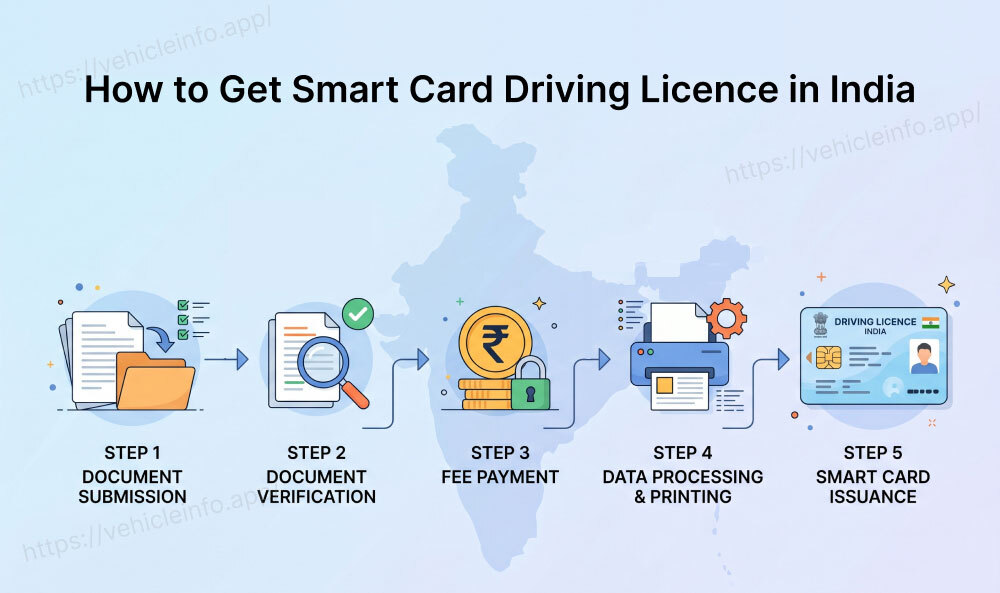
Converting an old paper or laminated DL to a smart card DL India follows the same process as applying for a duplicate or corrected DL. When applying for a smart card DL online, you are essentially requesting a new physical card to be issued for your existing record.
To apply for a smart card DL conversion, follow these simple steps:
Step 1: Go to parivahan website
Step 2: Select ‘Online Services’
Step 3: Then select ‘Driving Licence Related Services’
Step 4: Then select your state.
Step 5: Log in to your Parivahan account.
Step 6: Click on ‘Apply for Services on Driving License’ and enter your current DL number and date of birth.
Step 7: Upload the required documents, such as a scanned copy of your old driving license, address proof, and ID proof.
Step 8: Pay the replacement/smart card conversion fee (typically ₹200–₹500 depending on the state).
Step 9: Book a slot for biometric verification at your RTO, if required.
Step 10: After biometric verification (photo and fingerprint), the new smart card will be sent via speed post to your registered address.
Once applied you can track your DL application status online to monitor processing and dispatch updates. In most states, no RTO visit is required for a straightforward old DL to smart card conversion. Once applied, your updated smart card is dispatched by Speed Post. Some states may require additional biometric verification and slot booking, as indicated by the Sarathi portal.
Documents Required for Smart Card DL Conversion
When applying for a smart card DL conversion, you will be asked to either present or upload a few documents (as applicable). The list of documentation for smart card DL conversion is minimal and includes the following documents:
- Existing DL: a photo or scan of your current paper/laminated card
- Proof of address: Aadhaar, Voter ID, or recent utility bill (only required if your address has changed since original issue)
- Passport-size photographs: 2 recent photos with a white background
- Form 1: Medical self-declaration (filled online during the application)
No age proof or additional identity documents are needed unless your personal details are also being corrected simultaneously in the update application.
Check the complete list of documents required for a driving licence in India in this guide.
Fees for Smart Card DL Conversion
The fees for converting an old DL to smart card DL vary by state. The common average fee for smart card DL conversion in India includes:
| State / Category | Approximate Smart Card DL Fee |
|---|---|
| Most states (standard LMV/MCWG) | ₹200 to ₹400 |
| With an address or name change combined | ₹300 to ₹600 |
| Transport/HMV class conversion | ₹300 to ₹600 |
While the above-mentioned table lists out the common fee structure for smart car DL conversion, the laminated DL to smart card conversion cost for every state is transparently displayed on the Sarathi portal before payment. The smart card conversion fee is a one-time expenditure and includes both the chip card production and Speed Post dispatch.
Processing Time for Smart Card DL Conversion
After submitting your conversion application, you can expect to receive your new chip-based DL as per the following timelines:
- Smart card production: 5 to 10 working days
- Dispatch via Speed Post: 1 to 3 working days after production
- Delivery: 3 to 7 working days after dispatch
The total typical timeline is about 2 to 3 weeks from application date to card in hand. During this period, your existing paper DL remains valid for all legal purposes.
Additionally, once your DL record is confirmed active in the national Sarathi database, you can set up DigiLocker or mParivahan for immediate digital access. You do not need to wait for the physical smart card to arrive.
Is Smart Card DL Mandatory in India?
Possessing a physical smart card DL is not currently mandatory in India. The older paper-based laminated DLs issued by RTOs before the smart card era remain legally valid. MoRTH has not issued a directive mandating conversion by a specific date. However, there are strong practical reasons to convert:
Electronic Verification
Smart card DLs are verifiable using RTO devices at traffic checkpoints. Paper DLs, on the other hand, cannot be electronically verified. Therefore, in case the DL holder does not possess a Digital DL, producing the physical DL is the only way out of a police check.
DigiLocker and mParivahan Access
While DigiLocker and mParivahan DL access work based on your DL record in the Sarathi database (not the physical card format), updating to a smart card ensures your record is fully current and accurately reflects your details.
International Use
Embassies and international institutions increasingly require machine-readable travel and identity documents. Thus, a smart card DL is more universally recognised than an older laminated card.
Durability and Security
Smart cards resist water, heat, and physical damage significantly better than laminated paper DLs. Thus, with a chip-based smart card DL, you can ensure that you remain compliant at all times without the stress of proper storage.
Given that the conversion to smart card DL costs between ₹200 and ₹400 and takes under three weeks of processing time, converting to a smart card DL is a straightforward upgrade for anyone still carrying an older format DL.
Follow this easy guide to get your duplicate driving licence online in India without hassle.
FAQs
1. How do I convert my old driving licence to a smart card?
Ans: Apply via the Sarathi portal by visiting the Parivahan Portal and then select Duplicate DL or Smart Card Conversion under the DL services tab. Upload your existing DL photo, a recent passport photograph, and address proof if your address has changed. Pay the smart card DL fee online. The smart card is dispatched within 2 to 3 weeks.
2. Is the smart card DL mandatory in India?
Ans: No. Older, paper-based, laminated DLs remain legally valid. While conversion to a smart, chip-based DL is recommended, it is not currently compulsory under the Motor Vehicle Act or any other rule.
3. What is the difference between a smart card DL and a digital DL?
Ans: A smart card DL is a physical plastic card with an embedded microchip. A digital DL (DigiLocker or mParivahan) is a cloud-based document with no physical form. Both are legally valid under the Motor Vehicles Act. The digital DL is best for daily use, while the smart card DL is best when a physical credential is required.
4. Can I get a smart card DL if my original DL was issued in a different city?
Ans: Yes. You can apply for a smart card DL conversion regardless of which RTO originally issued your DL. The conversion is processed through the same state's Sarathi portal and dispatched to your current registered address.
5. How long does smart card DL processing take?
Ans: Approximately 2 to 3 weeks from application submission to delivery. Track your application status on parivahan.gov.in using your application number.