Traffic Fines in India (2026): Complete Penalty Chart Under the Motor Vehicles Act
08 June, 2026
If you drive on Indian roads, knowing the traffic fines India framework is not just useful: it is essential. The Motor Vehicles (Amendment) Act, 2019 dramatically increased penalty amounts across almost every category of traffic violation, in many cases by five to ten times the earlier amounts. The intent was to make traffic rules and fines serious enough to actually change driver behaviour. Five years on, the fine structure introduced by the 2019 amendment remains in force nationally, and enforcement has become more systematic than ever with ANPR cameras and e-challan systems now active across most major cities and highways.
Understanding the current traffic fines India system matters whether you are a daily commuter, a long-distance trucker, or someone who drives occasionally. The fines are high enough to be meaningful, and the e-challan infrastructure means violations are increasingly captured automatically without any officer stopping you. An ANPR camera on the expressway does not care whether you think you were driving safely.
This guide brings together a complete traffic penalty chart covering all major violations, explains the state-wise fine variations that catch many drivers off guard, and tells you exactly how these fines are detected, issued, and paid. Whether you are looking for a quick challan amount India reference or want to understand the full picture of MV Act fines and how they work, this is your complete resource.
How the 2019 MV Act Amendment Transformed Traffic Fines in India
Before the Motor Vehicles (Amendment) Act, 2019, traffic fines in India were embarrassingly low by international standards. Driving without a helmet attracted a fine of just Rs 100. Using a mobile phone while driving was Rs 100. Drunk driving was Rs 2,000 on a first offence. These amounts were so negligible that they had minimal deterrent effect.
The 2019 amendment completely overhauled this structure. Traffic fines after 2019 amendment are several times higher across every category. The revision was backed by data showing that India accounts for a disproportionately high share of road fatalities globally, and that inadequate penalties were one of the contributing factors.
Key changes under the Motor Vehicles Act penalties post-2019:
- Helmet fine increased: from Rs 100 to Rs 1,000
- Mobile phone use while driving: from Rs 100 to Rs 1,000 (first offence) and Rs 2,000 for repeat
- Overspeeding fine: from Rs 400 to Rs 1,000-4,000 depending on vehicle type and location
- Drunk driving (first offence): from Rs 2,000 to Rs 10,000 plus up to six months imprisonment
- Driving without licence: from Rs 500 to Rs 5,000
- Driving without insurance: from Rs 1,000 to Rs 2,000
The 2019 amendment also introduced the concept of enhanced penalties for juvenile driving, where a guardian can be held liable for a fine of Rs 25,000 and the vehicle's registration can be cancelled. It also created provisions for community service as an alternative to fines in certain cases.
Traffic violation fines India 2026 operate under this framework. There has been no major central revision since 2019, though individual states have added supplementary penalties in some categories.
Complete Traffic Penalty Chart: All Major Violations and Fines
The table below is the most comprehensive traffic penalty chart available for India's current fine structure under the Motor Vehicles Act.
| Violation | First Offence Fine | Repeat Offence Fine |
|---|---|---|
| Riding without a helmet | Rs 1,000 | Rs 1,000 |
| Not wearing a seatbelt (front) | Rs 1,000 | Rs 1,000 |
| Not wearing a seatbelt (rear) | Rs 1,000 | Rs 1,000 |
| Using mobile phone while driving | Rs 1,000 | Rs 2,000 |
| Jumping a red light | Rs 1,000 to Rs 5,000 | Rs 10,000 |
| Overspeeding (light vehicle, city) | Rs 1,000 to Rs 2,000 | Rs 2,000 |
| Overspeeding (medium vehicle) | Rs 2,000 | Rs 4,000 |
| Overspeeding (heavy vehicle) | Rs 4,000 | Rs 4,000 + possible disqualification |
| Drunk driving (first offence) | Rs 10,000 + up to 6 months jail | Rs 15,000 + up to 2 years jail |
| Rash or negligent driving | Rs 1,000 | Rs 2,000 |
| Driving without a valid licence | Rs 5,000 | Rs 10,000 |
| Driving without valid insurance | Rs 2,000 | Rs 4,000 |
| Driving without PUC certificate | Rs 10,000 | Rs 10,000 |
| Overloading passengers (transport vehicle) | Rs 1,000 per extra passenger | Rs 1,000 per extra passenger |
| Overloading goods vehicle | Rs 20,000 + Rs 2,000 per extra tonne | Rs 20,000 + Rs 2,000 per extra tonne |
| Triple riding on a two-wheeler | Rs 1,000 | Rs 1,000 |
| Driving wrong side or wrong lane | Rs 1,000 to Rs 5,000 | Rs 10,000 |
| Tinted glass violation | Rs 500 | Rs 1,500 |
| Racing on public roads | Rs 5,000 | Rs 10,000 + 3 years imprisonment |
| Not giving way to an emergency vehicle | Rs 10,000 | Rs 10,000 |
| Disobeying a traffic sign or signal | Rs 500 to Rs 5,000 | Rs 1,500 to Rs 10,000 |
| Wrong parking | Rs 500 to Rs 1,000 | Rs 1,000 to Rs 2,000 |
| Driving without fastened seat belt (rear seat) | Rs 1,000 | Rs 1,000 |
| Juvenile driving (guardian penalised) | Rs 25,000 + RC cancellation | Rs 25,000 + RC cancellation |
This traffic penalty chart reflects the central government fine structure. State governments can impose additional fines on top of these amounts but cannot reduce below them.
The Top 10 Most Common Traffic Violations and What They Actually Cost
Understanding which violations generate the most challans helps you prioritise what to avoid. Based on e-challan data and traffic police records, here are the ten most frequently issued fines in India and the challan amount India drivers most commonly pay.
Helmet non-compliance is the single most issued category across the country, particularly in cities with high two-wheeler usage like Chennai, Bhopal, and Patna. At Rs 1,000 per offence, the helmet fine is one of the most immediately impactful changes from the 2019 amendment and has contributed to measurable increases in helmet use in several states.
Mobile phone use while driving is the second most common violation by volume. At Rs 1,000 for a first offence and Rs 2,000 for repeats, this is also among the easiest to detect through CCTV cameras at urban junctions.
Red light jumping is the third most common, with the traffic challan rates India framework setting the fine between Rs 1,000 and Rs 5,000 depending on the city and the specific circumstances. Cities with high-density CCTV coverage like Delhi, Bengaluru, and Chennai generate the largest red light fine volumes.
Overspeeding on highways is the dominant ANPR camera violation. The speeding fine India range of Rs 1,000 to Rs 4,000 applies, with the higher end for medium and heavy vehicles. States with active ANPR deployment on national highways, such as UP, Gujarat, and Maharashtra, generate very high overspeeding challan volumes.
Drunk driving penalties, while less frequent in volume, represent the highest single-incident fine in the traffic fines India framework. The drunk driving penalty of Rs 10,000 plus possible imprisonment for a first offence, and Rs 15,000 plus up to two years imprisonment for a repeat offence, make it the most expensive encounter a driver can have with traffic enforcement. In Gujarat, the drunk driving penalty carries additional consequences under the state's prohibition law, making it uniquely serious.
Driving without a licence (Rs 5,000) and driving without insurance (Rs 2,000) also appear consistently in the top ten nationally, driven by high rates of non-compliance particularly among two-wheeler riders in rural areas. The wrong-side driving and rash driving categories round out the most common categories in urban enforcement zones.
State-wise Fine Variations: Why Delhi Fines Can Be Higher
The national traffic fines India structure sets a floor, not a ceiling. States have the authority to impose additional fines and surcharges on top of central rates, which is why traffic violation fines India 2026 can look different depending on where you are driving.
Delhi is the most notable example. The Delhi Motor Vehicles Rules allow the traffic police to impose compounding fees that are higher than the central rates for certain violations, particularly for commercial vehicles and for violations within school zones or no-parking areas. Delhi also applies stricter enforcement and higher penalties for pollution certificate violations (PUCC non-compliance), where the Rs 10,000 central fine is enforced rigorously. Traffic fines India data consistently shows Delhi at the top for both challan volume and average fine amount.
Maharashtra, particularly in Mumbai, follows the central fine structure but applies enhanced penalties for certain commercial vehicle violations. Overloading fines in Mumbai are consistently enforced, and the combination of the central fine plus transport authority penalties can significantly exceed the base amount.
Karnataka and Bengaluru have been known for periodic crackdowns with enhanced enforcement, particularly during traffic awareness drives, though the base fine structure follows the national framework.
Gujarat follows national rates strictly but is notable for the additional consequence that drunk driving carries under the Gujarat Prohibition Act, making it the most expensive state in which to be caught drink driving. The combination of traffic fines India under the MV Act and Gujarat Prohibition Act penalties means a drunk driving stop in Gujarat can have life-altering financial consequences.
The most accurate answer to why Delhi fines can be higher than in other states is that Delhi's traffic police have more active enforcement infrastructure, higher patrol intensity in central areas, and supplementary state rules that allow penalties above the central floor.
How Traffic Violations Are Detected and Enforced in 2026
The way traffic fines India are generated has changed dramatically. In 2026, three enforcement channels operate simultaneously:
CCTV cameras at signalised intersections form the backbone of urban enforcement. Over 1,000 cameras operate in Delhi alone, and cities like Chennai, Bengaluru, Hyderabad, and Mumbai have extensive networks. These cameras detect red light jumping, mobile phone use, and seatbelt non-compliance automatically, generating e-challans without any officer being present.
ANPR cameras on national highways and urban expressways detect overspeeding in real time. The camera captures an image of the vehicle, reads the number plate, cross-references the permitted speed, and generates a challan if the vehicle is over the limit. ANPR enforcement is active on most national highways across UP, Gujarat, Maharashtra, Rajasthan, and Karnataka.
Handheld e-challan devices are used by traffic officers during patrol. When an officer stops a vehicle for a violation, they enter the details directly into the device, which is linked to the Parivahan database. This generates an instant digital challan.
The combination of these three channels means that traffic rules and fines are increasingly impossible to ignore. Traffic fines India are now enforced through a system that operates 24 hours a day without requiring any officer to be present, which is why violations are documented automatically and linked to the vehicle's registration number.
How to Check and Pay Your Traffic Fine Online
If you have received an SMS about a pending fine or want to check whether your vehicle has any outstanding challan amount India records, here is how to do it.
The fastest method is the Vehicle Info platform at vehicleinfo.app/pay-challan-online. Enter your vehicle registration number and all pending challan records appear in one view. Payment via UPI, debit card, credit card, or net banking can be completed in under two minutes.
The official Parivahan portal at echallan.parivahan.gov.in also shows all pending challans by vehicle number and supports direct payment. State police portals provide an additional check for challans that have not yet synced with the national database.
Traffic fines India must be paid before RC renewal, DL renewal, or vehicle transfer can be processed. The sooner you check and clear any outstanding fines, the fewer complications you face with routine vehicle compliance tasks.
Can Traffic Fines Be Reduced Through Lok Adalat?
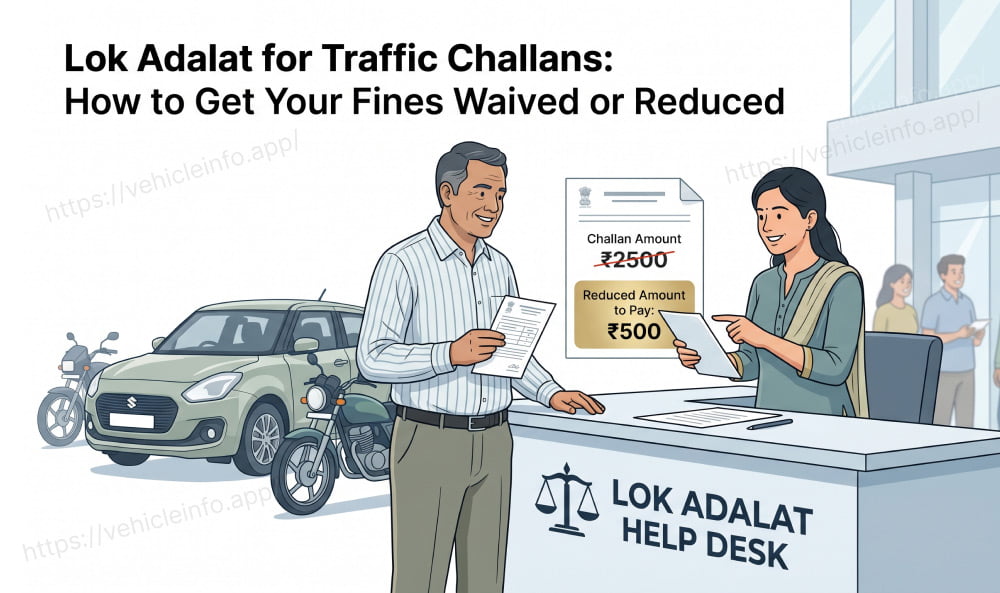
Yes. For challans that have been referred to a traffic court, Lok Adalat sessions offer the opportunity to settle at a significantly reduced amount. The MV Act fines structure sets the original penalty, but at Lok Adalat the presiding officer has discretion to accept a lower settlement figure. Reductions of 50 to 75 per cent are common for older challans, and some very old cases are settled at reductions of up to 90 per cent.
National Lok Adalat sessions are held four times a year. For challans still in the regular online payment window, paying directly through Parivahan or Vehicle Info is faster and more straightforward. The traffic fines India payment process takes under two minutes online, compared to hours at a Lok Adalat session.
FAQs
1. What are the current traffic fines in India in 2026?
Ans: Traffic fines India in 2026 operate under the Motor Vehicles (Amendment) Act, 2019, which set the current national fine structure. Key amounts include: helmet fine Rs 1,000, seatbelt fine Rs 1,000, red light jumping Rs 1,000 to Rs 5,000, overspeeding Rs 1,000 to Rs 4,000, drunk driving Rs 10,000 plus jail (first offence), no licence Rs 5,000, and no insurance Rs 2,000. No major central revision has occurred since 2019.
2. How much is the fine for speeding in India?
Ans: The speeding fine India amount depends on the vehicle type and location. For light vehicles in a city, the fine is Rs 1,000 to Rs 2,000. For medium vehicles, it is Rs 2,000. For heavy vehicles or highway overspeeding, fines range from Rs 2,000 to Rs 4,000. What is fine for speeding in India on a highway under ANPR surveillance is most commonly Rs 2,000 to Rs 4,000 for light vehicles.
3. How much is the fine for speeding in India?
Ans: The speeding fine India amount depends on vehicle type and location. For light vehicles in a city, it is Rs 1,000 to Rs 2,000. For medium vehicles, it is Rs 2,000. For heavy vehicles or highway overspeeding, fines range from Rs 2,000 to Rs 4,000. What is fine for speeding in India on a highway under ANPR surveillance is most commonly Rs 2,000 to Rs 4,000 for light vehicles, and higher for trucks or buses.
4. Which traffic violation has the highest fine in India?
Ans: Which traffic violation has highest fine in India depends on the category. For individual incidents, drunk driving carries Rs 10,000 for a first offence plus jail. However, overloading goods vehicles can attract Rs 20,000 plus Rs 2,000 per extra tonne, which can total far higher amounts. Not giving way to an emergency vehicle and racing on public roads each carry Rs 10,000. Which traffic violation has highest fine overall therefore depends on whether you measure by base fine or potential total. Drunk driving and overloading compete for the top position.
5. How did traffic fines change after the 2019 amendment?
Ans: Traffic fines after 2019 amendment increased dramatically. Helmet fines went from Rs 100 to Rs 1,000. Mobile phone fines rose from Rs 100 to Rs 1,000. Drunk driving penalties increased from Rs 2,000 to Rs 10,000 plus jail. Driving without a licence went from Rs 500 to Rs 5,000. The 2019 Motor Vehicles Act penalties overhaul was the most significant revision to India's traffic fine structure in over two decades.
6. Are traffic fines the same in every state?
Ans: No. The national framework sets the minimum amounts, but states can impose additional fines. Delhi and Mumbai apply higher compounding fees for certain violations. Gujarat adds penalties under the Prohibition Act for drunk driving. Traffic challan rates India therefore vary state by state for the same violation, with the national MV Act fine as the base. Drivers crossing state lines should note that local enforcement rules may apply additional charges.
7. What is the fine for jumping a red light in India?
Ans: The red light fine in India is Rs 1,000 for a first offence and can go up to Rs 5,000 depending on the city and circumstances. For a repeat offence, the fine can reach Rs 10,000. The red light fine is one of the most commonly issued challans in urban areas where CCTV cameras are deployed at intersections. The exact amount on your challan depends on the issuing state's compound rates.
8. What is the fine for driving without insurance in India?
Ans: Driving without valid insurance attracts a fine of Rs 2,000 for a first offence and Rs 4,000 for a repeat offence under the Motor Vehicles Act penalties. This is separate from any civil liability that arises in the event of an accident. Driving without insurance is also a criminal offence under the Act and can lead to imprisonment of up to three months in addition to the fine.
9. How do I check the challan amount for my vehicle?
Ans: To check the challan amount India records for your vehicle, visit echallan.parivahan.gov.in or use the Vehicle Info platform at vehicleinfo.app/pay-challan-online. Enter your vehicle registration number to see all outstanding fines, the violation type, and the amount due. Both platforms support direct online payment through UPI, debit card, credit card, and net banking. Checking regularly ensures no challan accumulates interest through court referral.
10. What is the highest fine a traffic officer can impose on the spot in India?
Ans: For on-the-spot violations, officers use handheld e-challan devices and issue fines based on the traffic violation fines India 2026 schedule. The highest fines for on-the-spot offences are typically Rs 5,000 for serious signal or lane violations and Rs 10,000 for drunk driving. In practice, most spot challans are for helmet, seatbelt, and mobile phone violations at Rs 1,000 each.
11. Can old traffic fines from before 2019 still be collected?
Ans: Yes. Outstanding fines from before the 2019 amendment can still be collected at the original fine amounts. However, if the case has been referred to court after the 2019 amendment came into force, the court has discretion on the applicable fine amount. Traffic fines India from any period remain on the Parivahan system until they are paid or settled through Lok Adalat.