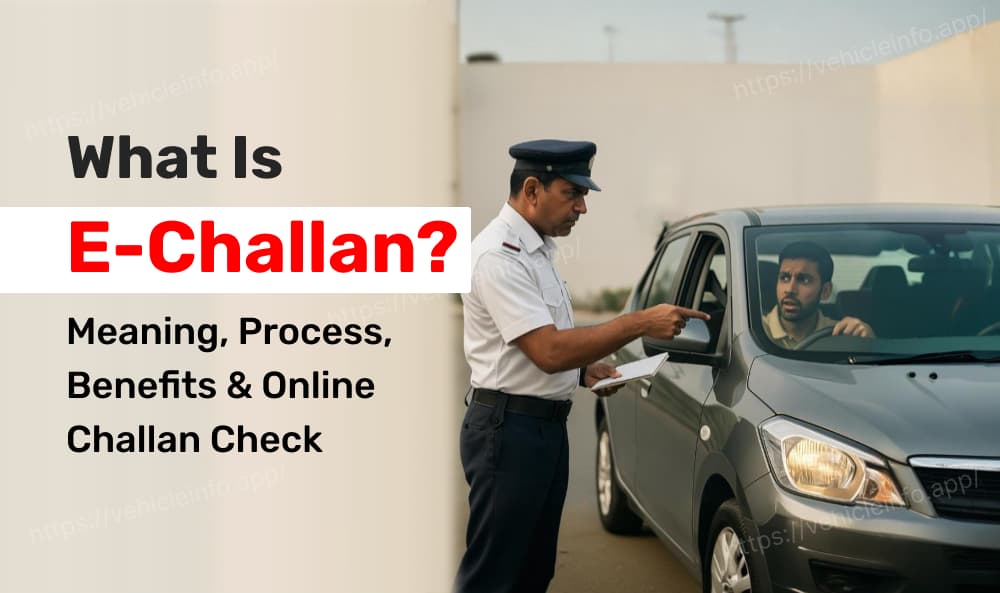
What is e-Challan? Meaning, Process, Benefits & Online Challan Check
20 November, 2025
The introduction of the online e-Challan system in India has revolutionized the way traffic violations are recorded, tracked, and settled. By replacing traditional paper challans with digital challans, the government has created a transparent, efficient, and smart traffic management system. Let’s explore how the traffic e-Challan system works, its benefits, technologies involved, and major initiatives by the authorities.
What is an e-Challan?
An e-Challan is a digitally generated traffic fine issued for violations such as overspeeding, red-light jumping, using a mobile while driving, not wearing a helmet or seatbelt, and wrong parking. Detection happens via CCTV surveillance, ANPR cameras, AI-based speed sensors, or manual entry by a traffic officer. Each e-Challan links to the vehicle registration number and is recorded in national databases such as VAHAN and SARATHI for accuracy and traceability.
The main goal: boost road safety, cut traffic rule violations, and promote responsible driving.
Also Read: How to Check Traffic Challan Online in India
How Does e-Challan Work in India?
Previously, traffic police managed violations manually—a slow, error-prone process. Today, digital automation and instant data verification power a system that is transparent, accurate, and user-friendly.
Flow of the e-Challan System
- Detection of Violation
Automated via CCTV, speed guns, ANPR, or police entry. - Recording of Offence
Details including date, time, vehicle number, violation type, and location are logged in national databases. - e-Challan Generation
The system creates a digital challan with a unique number, infraction evidence, and attaches it to the vehicle record. - Notification to Vehicle Owner
SMS and email are sent instantly, including info and a link to check challan online. - Check e Challan Status and Payment
User checks their e-challan status, verifies details, and pays via authorized online or offline portals. - Case Closure
After e-challan payment, status is updated to “Paid” and archived.
Tip: Always pay traffic e-Challans within 60 days to avoid extra penalties or court action.

Smart Technologies Used in the e-Challan System
- ANPR Cameras (Automatic Number Plate Recognition)
- AI-based Speed Sensors and Detection Systems
- CCTV Surveillance Networks
- Integrated Traffic Management System (ITMS)
- VAHAN & SARATHI Database Integration
- Secure Digital Payment Gateways
These combine to make real-time traffic monitoring, automatic e-challan generation, and instant online challan check possible.
Benefits of the e-Challan System
For Government & Authorities
- Improves enforcement of traffic laws
- Centralized monitoring with transparency
- Reduces manual errors and corruption
- Provides accurate data for analytics and planning
For Citizens
- Easy online e-challan check and payment via official portals
- Saves time—no need to visit physical offices
- Reduces risk from fraudulent, duplicate, or fake traffic fines
- Receives instant updates via SMS and email
Major Government Initiatives for e-Challan Management
- One Nation, One Challan (ONOC): Centralizes e-challan management via VAHAN & SARATHI, unifying tracking nationally.
- Smart ITMS e-Challan: Combines AI, camera networks, and database integration for end-to-end automation.
Traditional Challan vs e-Challan
| Comparison Factors | Traditional Challan | e-Challan |
|---|---|---|
| Issued By | Traffic Officer | CCTV, ANPR, digital system |
| Payment Mode | Offline | Online preferred |
| Transparency | Low | High |
| Processing Time | Slow/manual | Automated, instant |
| Human Intervention | High | Minimal |
| Risk of Bribery | High | Low |
| Record Keeping | Manual log | Digital archive |
Useful Portals for Challan Check and Payment
- MoRTH: For official updates, rules, notifications, and e-challan policies
- Parivahan: To check e-challan status, verify vehicle challan details, and pay challans online
- State Traffic Police Websites: For region-specific traffic e-challan management and payment
Conclusion
The e-Challan system has modernized and streamlined India’s traffic fine process—making payments, status checks, and compliance easy for everyone. To avoid late penalties, always check challan online and pay fines promptly. Responsible driving and timely e-challan payments help keep roads safer and your records clean.
FAQs
1. How long does an e-Challan take to reflect after payment?
Ans: Usually 24–48 hours. Always recheck challan status online after payment to confirm Closure.
2. Is it safe to pay e-Challan online?
Ans: Yes—use official portals such as Parivahan or state transport websites for secure payments.
3. Can I check someone else’s e-Challan details?
Ans: You can look up any vehicle’s e-challan status using its registration or challan number, as public records are linked to VAHAN.
4. How to verify if an e-Challan is real or fake?
Ans: Only trust government portals—avoid suspicious links and check e-challan status through Parivahan or RTO websites.
5. What happens if I do not pay the e-Challan on time?
Ans: If overdue (generally 60 days), expect extra penalties, possible court proceedings, and even RC or license renewal blocks as part of ONOC. The system automatically escalates unpaid fines.